Showing posts with label Death. Show all posts

Thinking... Capital Punishment as Premeditated Murder

Albert Camus, Nobel prize winner, half-length ...Image via Wikipedia

Today is the day after. 

It's the day after Troy Davis was executed for the murder of Officer Mark MacPhail.  And it has me thinking about guilt and punishment and retribution and death.  Fun stuff for a Thursday morning.

But I wasn't prepared to think like this.  The following is a quote from Albert Camus, a writer who won a Nobel Prize for literature in 1957.  He's pictured above.

I had not thought of capital punishment like this.
"But what then is capital punishment but the most premeditated of murders, to which no criminal’s deed, however calculated it may be, can be compared? For there to be equivalence, the death penalty would have to punish a criminal who had warned his victim of the date at which he would inflict a horrible death on him and who, from that moment onward, had confined him at his mercy for months. Such a monster is not encountered in private life."
Albert Camus, writer, philosopher, Nobel laureate (1913-1960)

(HT/Virtual Methodist)
Enhanced by Zemanta

The Last Words of Troy Davis

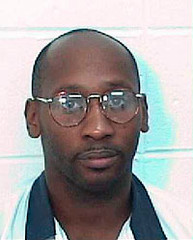
Troy DavisImage by Alain Bachellier via Flickr
I’d like to address the MacPhail family. Let you know, despite the situation you are in, I’m not the one who personally killed your son, your father, your brother. I am innocent. The incident that happened that night is not my fault. I did not have a gun. All I can ask … is that you look deeper into this case so that you really can finally see the truth. I ask my family and friends to continue to fight this fight. For those about to take my life, God have mercy on your souls. And may God bless your souls.

Davis was executed yesterday for the death of Mark MacPhail.  Seven out of nine eyewitnesses recanted their testimony. 

It's sad.

Davis' death.

Also MacPhail's death.

Sad.
Enhanced by Zemanta

The Business of the Church: Improving the Living or Raising the Dead?

"Christ Raising the Dead", Watercolo...Image via WikipediaEric Landry, over at Out of the Horse's Mouth, has what can be called, fairly, a scathing analysis of Willow Creek's Summit of business leaders and church leaders.  I think some of his criticism could be called, fairly, heavy handed.  I assume there are many things pastors of large or small organizations can learn from business leaders...from those who have found new and exciting and successful ways of leading people.  Lord knows I could learn a few things.

But, how much can we learn from business?  I know it is not terribly uncommon to hear business language in the church..."bottom line," "clients," even "product."  But the end goal of business is to make money.  While I'd love to be bringing in more money at our present church that's not "our business."  "Our business" isn't "getting more butts in the pews" -- although, again, it would be great if we had more of those as well.  Our business is offering Christ.  Our business is doxology, offering our praise.  Our business is discipleship.

Landry's most pointed, and I think strongest, theological argument is directed at Bill Hybells.  Here it is:

Bill Hybels said yesterday that the church is in the life transformation business. I’m glad to say that the Bible doesn’t support that view though it does seem to be a fairly common misconception today. We all want Jesus to come alongside us and improve us, our marriages, our children. We want to go to sleep at night confident that we have taken several steps forward, getting a little better every day. We want to reach the end of our lives and see that we have accomplished something of lasting significance and worth, to know that we were worth something. In all of these scenarios, however, Jesus is a means to an end (a very personal, therapeutic end: feeling better about ourselves). As one new acquaintance said at dinner last night, the problem isn’t that we need to align our hopes and dreams with Jesus; it’s that Jesus upends our hopes and dreams, intruding into our lives with such force that what we thought was important actually dies and new life is born in its place. As the great Episcopal preacher Robert Farrar Capon puts it, “Jesus came to raise the dead. He did not come to teach the teachable; He did not come to improve the improvable; He did not come to reform the reformable. None of those things work.” As long as the church thinks it is in the life business instead of the death business, it will constantly clamor after every tool to improve life and it will judge its success in the way that bookkeepers and accountants judge success.

Oooh... there's a few things I want to pull out of here.

I don't think I'd say that the church isn't about transformation, at least as the author here does.  It is true that much of contemporary Christianity is about "making you a better you."  It's about "improving the living."  That is partly why we now offer Alcoholics Anonymous and a Grief Support Group and why we've offered Financial Peace University.  But the author is right that this can't be the primary goal of the church and every sermon series on "Five Easy Steps to Improve Your Marriage" moves us closer to a gospel of self-help.  That's not the Gospel of Christ.

Secondly, that Robert Capon quote rocks.

Lastly, I do love the phrase "as long as the church thinks it is in the life business instead of the death business, it will constantly clamor after every tool to improve life and it will judge its success in the way that bookkeepers and accountants judge success."  This hit a little too close to home as we move towards a new accounting of membership and attendance in our churches.  Whose model are we following here?

I think, as it comes down to it, if we are all about "improving the living" instead of "raising the dead" we are selling Christ short, we're reducing his incarnation, death, and resurrection into something that we can get from Oprah or the next big CEO.  There is something much more radical and, dare I say, transformational, at work as persons are raised to new life in Christ...not just a marginally better life in him.
Enhanced by Zemanta

What Stories Will You Tell At My Funeral?

Last evening I attended the funeral, the "celebration of life" as it were, for a wonderful person...Andy.  I did not know Andy very well, but I know his wife quite well and our family wanted to be there for her.  Though Andy had not been well for some time, he was full of life.  He was a man of God...one who "knew Jesus."  There were wonderful stories told by the family and there was a running display of pictures from his life, showing him as a baby, him playing soccer, him conquering mountains, him getting married.  And, since a big part of his 37 year history was an accident 16 years ago that left him a paraplegic, there were pictures of that wreck and pictures where it was clear the issue was never the fact that he was in a wheelchair.  As his father-in-law said to him when Andy was asking for his daughter's hand in marriage, it "wasn't the WHEELCHAIR that [he] was concerned about." "It was the MAN in the wheelchair that was the concern."  And Andy never gave any reason to be concerned.

The funeral, the accident in Andy's life, the sorrow of those present, reminded me again just how fleeting this life is and how wonderful it is to share stories of those we have loved and keep their memories alive.  It made me wonder what stories would persons say at my funeral?  What are the stories about me that persons think give and idea about who I am as a person and what I believe in?

What stories will you tell at my funeral?

Will you tell stories about how shy I was as a young kid, so scared of losing the Cub Scout Pinewood Derby race that I climbed out onto my roof in winter, just to avoid going?

Will you talk about my singing in the church choir growing up, in the back row with my friend Joel, on stage at many times of my life, or how I can get easily distracted when singing while leading worship and find myself...and the whole congregation singing the wrong words?

Will you share about my penchant for drama and theater?

Will you talk about my sense of humor?  I like to think of myself as a funny guy.  I'm sure there's something you could share?

Will you tell people about my fights for truth and justice...like when I got punched by Adam on the playground because he called a friend of mine "the N-word" or when, in college, I got kicked out of being president of my fraternity because I took a stand against hazing?

Will you talk about my love for my family and how my wife is my best friend and how I enjoy my time with my children...yes, all five of them...although my dog, Hurley remains my favorite?

Will you tell people about how I was as a pastor?  My sermons? Pastoral care?  The church I've helped to build?

Will there be some aspect of my faith that will be shared?  Will someone stand up and talk about how much I loved Christ and tried to follow him?  As I type this I'm concerned that it will be farther down the list than I hope.

Will someone talk about the technology stuff that I love?

Will you tell people how I tried to serve the community of Girdwood while I was here?

Will you say that I have loved?

Will you say that I have thought hard?

Will you say that I have felt deeply?

How would you help persons get a sense of who I am?

What stories will you tell at my funeral?

It's Just Death


Had a business meeting this morning at the church. We seem to have a lot of those throughout this whole process of building a church. There's always an issue of money or construction or some important decision that needs to be made. Today was one of those meetings.

The person I was meeting with was quite a bit older than I am. He's lived a lot of life and the hope is that his perspective on some financial issues would be helpful to the congregation. This is someone I greatly appreciate and we were left making some small talk as we waited for the other parties to arrive. It seems this person had just lost a friend of his...someone he had known in the community for 40 years or so. Long-time friend. As he talked and shared some of the characteristics of the friend who had passed away, he kind of shrugged. He recounted that, upon his friend's death he thought he might want to get in touch with some of the crowd the two of them had hung out with in the past. However, there wasn't anyone left in the crowd. Everyone else had died.

I asked how a mutual friend was doing, someone who had been fighting illness for some time. What he said kind of threw me for a loop. He said, "We all know that [said person] is just going to go downhill and will then "pass.". There was a nonchalantness to his voice. There was a matter-of-factness to the look on his face. It was if he was saying... "Oh well, it's just death."

Now I think I need to be clear here that this was really not some grand statement of faith, proclaiming that, since Christ has been raised from the dead "all will be well and all will be well and all manner of things will be well." No, this was a perspective of one who had been around the block, who had seen a lot of life...and a lot of death. This was a perspective shaped by age. Everyone dies. It's just death. It happens. What are you going to do? No tears. No emotion. Matter of fact.

While some might view this response, this lack of shrinking before the mystery of death as cold...callous...as I reflect on this conversation, I can't help but find it somewhat refreshing. While my views might be more grounded in faith language, it is "just death.". Sure, it can be more tragic--as when the deceased is young, or leaves behind a young family, or dies in a horrible way. Yes, that's more tragic and will lead to other emotions and tears and anger. But for those who die of natural causes...even it it's because of personal choices that had been made earlier (the friend who had died had been a smoker), the fact that we die shouldn't be a surprise.

I hope that, because of my faith, I live as someone who is prepared to die. And perhaps, when I'm as old as the person I met with today, I can accept the simple fact that death is something that lies ahead for all of us. Perhap knowing that will affect how I live my life today.

NT Wright Speaks On American Exceptionalism and the Death of Osama bin Laden

NT Wright at Park Street ChurchImage by Rachel Ford James via FlickrI read a few blogs from Great Britain, assuming that heaing a European perspective balances out some of the American viewpoints I get, merely from the air I breath. 

This was found over at Ruth Gledhill's blog from across the pond.  I think it tries to put the American mission to get bin Laden into a different perspective.  On that blog you will also find a video of the Archbishop of Canterbury condemning the manner with which the mission was carried out.

But I thought Wright's stuff was thought-provoking:

Consider the following scenario. A group of IRA terrorists carry out a bombing raid in London. People are killed and wounded. The group escapes, first to Ireland, then to the United States, where they disappear into the sympathetic hinterland of a country where IRA leaders have in the past been welcomed at the White House. Britain cannot extradite them, because of the gross imbalance of the relevant treaty. So far, this is not far from the truth.

But now imagine that the British government, seeing the murderers escape justice, sends an aircraft carrier (always supposing we’ve still got any) to the Nova Scotia coast. From there, unannounced, two helicopters fly in under the radar to the Boston suburb where the terrorists are holed up. They carry out a daring raid, killing the (unarmed) leaders and making their escape. Westminster celebrates; Washington is furious.

What’s the difference between this and the recent events in Pakistan? Answer: American exceptionalism. America is allowed to do it, but the rest of us are not. By what right? Who says?

Consider another fictive scenario. Gangsters are preying on a small mid-western town. The sheriff and his deputies are spineless; law and order have failed. So the hero puts on a mask, acts ‘extra-legally’, performs the necessary redemptive violence (i.e. kills the bad guys), and returns to ordinary life, earning the undying gratitude of the local townsfolk, sheriff included. This is the plot of a thousand movies, comic-book strips, and TV shows: Captain America, the Lone Ranger, and (upgraded to hi-tech) Superman. The masked hero saves the world.

Films and comics with this plot-line have been named as favourites by most Presidents, as Robert Jewett and John Shelton Lawrence pointed out in The Myth of the American Superhero (2002) and Captain America and the Crusade Against Evil (2004). The main reason President Obama has been cheered to the echo across the US, even by his bitter opponents, is not simply the fully comprehensible sense of closure a decade after the horrible, wicked actions of September 11 2001. Underneath that, he has just enacted one of America’s most powerful myths.

Perhaps the myth was necessary in the days of the Wild West, of isolated frontier towns and roaming gangs. But it legitimizes a form of vigilantism, of taking the law into one’s own hands, which provides ‘justice’ only of the crudest sort. In the present case, the 'hero' fired a lot of stray bullets in Iraq and Afghanistan before he got it right. What’s more, such actions invite retaliation. They only ‘work’ because the hero can shoot better than the villain; but the villain’s friends may decide on vengeance. Proper justice is designed precisely to outflank such escalation.

Of course, ‘proper justice’ is hard to come by internationally. America regularly casts the UN (and the International Criminal Court) as the hapless sheriff, and so continues to play the world’s undercover policeman. The UK has gone along for the ride. What will we do when new superpowers arise and try the same trick on us? And what has any of this to do with something most Americans also believe, that the God of ultimate justice and truth was fully and finally revealed in the crucified Jesus of Nazareth, who taught people to love their enemies, and warned that those who take the sword will perish by the sword?

Enhanced by Zemanta

A Resurrection Poem

The Orange Mold on the Churchyard TombstonesImage by Stuck in Customs via FlickrAccording to Jared Wilson, from whose blog I got this, this is a poem engraved on the tomb of CS Lewis' wife, Joy.

Here it is:

Here the whole world (stars, water, air
And field, and forest as they were
Reflected in a single mind)
Like cast off clothes was left behind
In ashes, yet with hope that she,
Re-born from holy poverty,
In lenten lands, hereafter may
Resume them on her Easter Day.
Enhanced by Zemanta

"Create in Me the Life of Laughter"

202/365 - Laughphoto © 2008 Gillian C | more info (via: Wylio)


Working on a memorial service today.  Trying to find joy in sorry.  Trying to preach resurrection in the midst of death.   Proclaiming the love of Christ while realizing there are those who long to feel that love.  Searching for joy to enter some broken hearts.

Found this over at Allan Bevere's site:


Jesus, I believe you laughed as Mary bathed you and Joseph tickled your toes. I believe you giggled as you and other children played your childhood games. And when you went to the Temple and astounded the teachers, I believe you chuckled as all children chuckle when they stump adults. And surely there were moments of merriment as you and your disciples deepen you relationship. And as you and Mary and Martha and Lazarus fellowshipped, mirth must have mirrored your faces.

Jesus, I know you wept and anguished. But I believe you laughed too. Create in me the life of laughter.*

Yes, suffering and despair are to be taken seriously; and that is precisely why the Christian life is a life of joy. In the midst of it all, God has made a way out. In the middle of our lost ways, God has found us. Only God can destroy death and defeat darkness. Only God can turn our despair into joy. Only God can turn sorrow into laughter. Only God can turn cross into resurrection.

The worst that can happen to us cannot compare with the best God has already accomplished for us in Jesus Christ!
___
*Cal & Rose Samra, Holy Humor (New York: Mastermedia Limited, 1996).

Suicide--My Pastoral Perspective (Part 1)

Angel of Death and the Sculpture -Daniel Chester Frenchphoto © 2006 Mark Skrobola | more info (via: Wylio)

Note:  This is Part 1 in a Three-Part Reflection on Suicide from the Pastoral side of things.  Here I'll set the stage for my reflection and share some advice and words I received from other clergy.  In Part 2 I'll share some of the words and illustrations that helped me be pastor throughout this difficult situation.  In Part 3 I'll share just a little bit about my own emotional journey.

I don't want to talk about the families involved or the deaths as I want to respect the privacy of the families and don't want to say anything that would get in the way of the healing which will need to occur in their lives.  So, I'm only going to write those things I think would be helpful to clergy as they counsel in the midst of a traumatic death and things I would say to either of these families or any other.  

This is about my reaction to the events.  This is part of my process of trying to think through the pastoral issues and to let some of my friends and colleagues see how their words and support have been helpful.  I have spent a great deal of time with this post trying to say what I want to say, without saying too much. 

If you read this and say, "I know who he's talking about" you probably do.  I ask that you offer whoever it is the respect and space they need as they continue recover.  And, if any of the words shared here can shape the words you share with them, then this has been a helpful exercise as our extended Christian community shows its love to those involved in the crises that I entered into or other instances of suicide that we encounter as we serve our God.


In November, someone connected to my church family committed suicide.   Also, in November, a member of my extended family committed suicide.  My congregation and my sisters and brothers in the clergy in Alaska are aware of this and they all have been very supportive.

In both instances, these are people I know and families I love.  It was, as should be expected, exceptionally traumatic for all persons who were touched by the deaths.  And, while I had performed funerals for suicide victims before, this was the first time I had really known the person before the death and the first time I was going to be called on to provide spiritual care after the fact.  I was really going to have to be "pastor" here.

As pastor, it's a whole lot more difficult when you can't just ride into the horrible situation, like the spiritual cavalry, to save the day.   If you're just called on to "help out" a local family that you don't really know it's easier.  You meet with the family.  You plan a nice funeral saying all the things you really should say about Christ and death and resurrection and hope and faith and comfort...  And then you go home, perhaps following up with the family once or twice, depending on what it seems the long-term relationship should be.  No long-term investment really asked for.

This was different.  In both cases.

These were folks I love.  I loved them before this tragic day.  I am going to love them long after it.  I found my heart broken along with theirs.  And, I want nothing more than peace and wholeness and grace and the comfort of God for them. 

Particularly with the local persons, I was going to have to put a whole lot more of myself into this.  I was going to have to rely more on God's presence and power and grace to make it through.  It was going to be painful.  But it was also going to be intimate.  As pastor, there is a holiness associated with entering the dark places of life and death with families, journeying with them in the valleys, trying, as best one can, to offer Christ, to share a word of love and grace, to bear some of the immediate burden with them, giving them a God to hold onto when the world is spinning out of control.  Sometimes we do this in a floundering manner, but other times the Holy Spirit enters in in a powerful way and comfort takes the place of the pain, if for just a moment.

This gave me a lot of time to think about suicide, from a pastoral perspective.  It is, perhaps, not something that I'd done a whole lot of.  In fact, I really hadn't done much thinking about or teaching about or praying about death over my ten years here in Girdwood because so few people had died.  I'd only done two funerals for anyone connected to the church at all.   For years I'd said that every funeral, every death, gave me a chance to talk about the resurrection of Christ; that every death was a mini-Easter for those who put their hope in Christ.  It's easier to say when not in the midst of the pain and trauma and hearing the voices and seeing the faces of those who love and hurt.

This was different. I knew it.  And, now after more reflection leading into December, I'm still aware that this is the case.

Early in the process of my entering into the situation as pastor, I sent a Facebook message to some clergy, asking for advice on how to be a pastor throughout this.  I knew the hurting family shouldn't be in this alone.  I figured I should not be in this alone either.  I got replies from several including:

Romans 8:38-39 "... neither death, nor life, nor angels, nor principalities, nor present things, more future things...shall separate us from the love of God...." Be present and embrace them in love. Peter's words resonate, "God replaces the pain with love." (From a Pastor/Counselor)

and

The people who are left behind pay a tremendous cost. We as humans build these family units and take care of each other, that is the primary job of family is to take care of each other. So when someone we love takes their life, the family feels like they have failed. And that they could have done something to prevent this from happening. There is no logic to this but, THERE IS NOTHING THEY COULD HAVE DONE TO STOP IT. And that is where your job comes in I believe. (From a Pastor)
and

Your presence, your willingness to walk with the family through all the complicated stages of suicide-induced grief and anger, are the greatest gift you can give. And speak often of God's grace... something we don't deserve, but get anyway... reminders that God weeps with us, that God has felt the pain of the man who took his life, that God feels our pain, that God replaces the pain with love... (From a Pastor)

and

Jim, if you chose to emphasize the grace and mercy of God, rather than where this man's son "went" that is a very wise thing.  (From a Pastor)

and, after a blog post on this site where I said, "I'm Not OK" I had this message from a colleague who had experienced loss:

[We] were not OK for a long time. But in that time of being not OK, we did find some comforts. We found that the antidote for death is life. Whatever you do that is life-affirming or life-enriching will help you to eventually be OK again.  The most difficult part of dealing with death for us was the deadening feeling we had. By embracing life we were able to process death without parts of us dying as well.  (From a Friend)

I appreciate the support I received.  Some of these words have helped shape some of the long-term care needed by the family and the community.  And, if there's a family struggling with the effects of suicide in their lives, I hope these words can still provide comfort to them.

In Part 2 I'll share some of my own personal reflections and understandings throughout this time.

Good Riddance, November. Don't Let the Door Hit You on the Way Out!

She left the Door openphoto © 2009 Hartwig HKD | more info (via: Wylio)
November was rough.  It drained me.  It was hard on me and many persons that I care about.

I came into November participating in two different productions--the "Halloween Train" Murder Mystery at Hotel Alyeska and the production of "Once Upon a Mattress" by (the still-forming) Girdwood Community Theater.  October 30th was the Murder Mystery.  October 31st was a Sunday with worship and Sunday School and Trick-Or-Treating with our little ones.  I was wore out.

But November came in and was ruthless.  Now, I know that this is not really the fault of any month.  But it's clear that this month, as I've said to some persons, "Kicked my butt."

On November 1st, someone connected with our church committed suicide.  It was traumatic for the the family, the community, and me.  While I had done funerals for suicide victims before, I don't think I'd ever been there "the night of" and followed up with the family over the next week.  I think I said some good things.  I think my presence was appreciated.  I think I was helpful and I think my presence made a spiritual difference through prayer and comforting words and merely by said presence.  This challenged me as pastor.  It also challenged my emotions as I love this family that was having to deal with the very sudden grief and pain and begin the healing process.  I did a lot of self-reflection throughout this process and was able to examine my own psychological and physiological responses to the hurt that I was feeling.  The Wednesday of that week I drove into Anchorage for a minister's lunch mainly because I needed the prayers to keep going.

Two weeks to the day after this, we had another traumatic death.  Again it was a family I loved and cared about. Again it was unexpected, though not suicide. It was a very painful scene.  It was in the middle of the night.  It was long.  My heart was broken as I could see and hear the brokenness of those I was called out to be with. It was November 17th that I wrote a blog post entitled "Dealing With Death/I'm Not OK."  And I wasn't OK.  I knew I would be OK.  But I wasn't at that moment.  It was going to take me time.  And it was clear that it took me about four days before I really felt like I could do any real work.  Also, it was clear that I didn't want to be alone.  I didn't want to be alone because it all felt too raw when I was left by myself.  I found comfort in the company of others.

In the midst of this we had rehearsals and three nights of production for "Once Upon a Mattress."

Then, a week later, on another dreadful Monday, we got word that a family member committed suicide in Indiana.  Really?!  Again!?  Here the difficult thing was our distance from the loved ones who were grieving.  You could hear the pain in the voices.  There were no indications that this was coming. There were no clues that anyone had.  Totally unexpected.

Three deaths in 21 days.  That was a lot.  That was a lot for me as pastor and a lot for me as...well...just me.

Then came Thanksgiving with a community dinner and all the celebrating that comes with that holiday.  Dinner with friends.  Kids home from school.  

Other pastors and people look to the holiday season and look at their December calendars and wonder how they are going to be able to get it all it.  This can be an overwhelming time and season and month for persons.

But I look toward tonight's exit of November with relief.  This was a tough month. 

I plan on embracing December and being embraced by God throughout all of it.  I plan to drink in the beauty of Advent and celebrate with my family and others all that this season means.  I look forward to the message of hope and love which comes with the birth of the Christ child and reminds us once again that God is in control and he, himself, has entered and is always entering this messy world of ours.  I pray for healing for myself and I pray for healing for those who have lost loved ones.

And November...good riddance.  Don't let the door hit you on the way out.

Sadness

de profundis / the depths of sorrowphoto © 2006 Eddy Van 3000 | more info (via: Wylio)
I'm OK...or at least I will be.  I'm trying to emotionally care for others and myself after some deaths in our congregation.  I'm trying to learn from this experience and not hide from it.  I'm trying to experience the grieving process even as I help others with theirs.  It's not easy when there's work to be done (charge conference and memorial service this weekend) and a play to put on (tonight is opening night).

I'll be OK.  But I am sad.  I do mourn.  My emotions have been hit hard. 

And, you know, that's OK as well.

I found this quote and thought it was highly appropriate.  The bold is my own.

When the church’s theological rejection of sadness was secularised, sadness became a pathology requiring medical intervention. The medicalisation of sadness is the final cultural triumph of the Protestant smile. If Luther or Kierkegaard or Dostoevsky had lived today, we would have given them Prozac and schooled them in positive thinking. They would have grinned abortively – and written nothing. The truth of sadness is the womb of thought.

(HT to Richard Hall, who got this from Ben Myers)
Enhanced by Zemanta

I Sometimes Feel Like the Angel of Death

Angel of the DeathImage via WikipediaHad another death in the community recently.  I'm going to be purposefully vague about it to keep the details private.  Like many deaths, it's not anyone who actually lives here but someone who was in the Girdwood area enjoying something the area has to offer -- fishing, hiking, skiing, etc.  On any given day, a lot of the people around here aren't actually from around here.  They're from Anchorage, or the Peninsula, or Outside, or overseas.  And this particular person was not from here.


I've been chaplain of the local Fire Department for the last nine years or so and death is one of the things I do...particularly if it's very traumatic for the first responders or if there are friends and family around at the time who need some emotional/spiritual care.  Part of the job is making sure the Fire Department and State Troopers can do their jobs.  Sometimes it's a matter of trying to calm down those who are distressed so that questions can be answered.  Sometimes I pray.  Sometimes I just listen.  Sometimes I'm just not sure what exactly it is that I should be doing.

I have found the chaplaincy to be a very rewarding part of my ministry over this time.   I can't say that I "enjoy" it.  But I can say that I'm appreciated by the Fire Department for the care I'm able to offer and I can say that my presence seems to be appreciated by those who are grieving and are mostly in shock at the scene of a death.  It's hard, but I feel like these times are holy times. 


There is a look of relief on the faces of some persons when I show up... on the mountain, on the trail, on the road, in a home.  The Fire Department may ready for me to deal with the grieving loved ones after they've been at a scene, hard at work, in "rescue-mode" for a while.  The family may be looking for someone to hold onto them and help them transition into all of the tough questions that are going to lie ahead.  Both may be happy to have someone there to be a go-between for communication.  It often helps to have someone who is not really a "rescuer" but understand what is going on.


But, there are those...particularly bystanders who know me...who see the Fire Department around and see me show up and come to the very valid conclusion that something bad is happening.  They're respectful.  They keep their distance.  But they realize that someone has died...when they see me.

At this recent death, I was waiting for loved ones to show up where I was so more loved ones could be brought together for the first time after hearing the news.  While waiting, someone who knew me, a friend with kids I know, started trying to talk with me...small talk...simple stuff.  My mind was focused on the arrival of the family members and the role I'd need to step into at that time.  I'd already been with some of them for a while.  And when the newly widowed woman arrived and embraced her child and cried in front of us, the look on my friend's face changed.   It sunk in what was going on. This friend pulled her kids away from that situation so the grieving could continue. 

There was hustle and bustle all around.  There was business.  There was travel.  There was eating.  There was laughing.  And, in the midst of it, a family crying.  It's kind of surreal when I look back on it.  Oftentimes, there is a small, intimate window full of pain and grief and love that kind of opens up in the real world.   It's strange.


Sometimes, in these situations, I feel like the angel of death. 

They are holy times and I know that God is using me to bring some peace to a very tumultuous place in the lives of persons. 

I just wonder how many persons think, "Oh no.  Jim's here.  Someone must have died."

Enhanced by Zemanta