Showing posts with label Church. Show all posts

"The Incarnation of the Piper"

The Pied Piper Of Hamelin

I see Christ as the incarnation of the piper who is calling us. He dances that shape and pattern which is at the heart of our reality. 

Sydney Carter

The Pastor's Wife

The Pastor’s Wife

by Judy Bowling

She’s a Godly woman, she has such grace
Always a warm greeting, a smile on her face
She’s always encouraging, she knows her place
She is – The Pastor’s Wife

She has to always look just right
Always on time, though the schedule’s tight
From early morning, till late at night
Always – The Pastor’s Wife

She’s such a Lady, everyone’s friend
She serves with love from deep within
All of the rifts she tries to mend
Oh she’s – The Pastor’s Wife

She carries your burdens, she prays for you
Sometimes she cries the whole night through
But you won’t know when she’s feeling blue
‘Cause she’s – The Pastor’s Wife

At church as she starts to walk up the aisle
So many needs to stop and talk for awhile
Though she is tired, she has her own trials
She’s patient, she’s – The Pastor’s Wife

Her life, her time is not her own
There’s always a need, they go on and on
With a knock on the door or a ringing phone
That’s the life of – The Pastor’s Wife

Her husband she shares with a whole congregation
She humbly accepts his intense dedication
In loneliness she kneels to seek consolation
God Bless – The Pastor’s Wife

She will someday reach the end of her race
As she meets her Master, face to face
Surely our God had a Special Place
In heaven for – The Pastor’s Wife


I post this in recognition of my lovely wife, who has been a "Pastor's Wife" for 18 out of our 20 years of marriage.


While the poem can be found here, I found it via Tony Jones' blog.

State of the Church -- Presented at Girdwood Chapel Charge Conference


State of the Church
Presented to the Girdwood Chapel Charge Conference
21 December 2011
by Pastor Jim Doepken

You already know this, I hope.  But we have some wonderful, holy, good things going on right now: 

·      We have a Food Pantry that is meeting more need than we knew existed and we’re trying to be part of the solution to the underlying problems of economic need in the community. 
·      We have a discipleship group that has been a wonderful exercise in following Jesus with the hope of expanding it to more groups in the coming year. 
·      We have bunches of youth coming to the Friday Night Live events and also to the Tween Group which meets before it.
·      We have the stirrings of a men’s group…a long way from our Women’s Bible Study…but we can dream.
·      We’re in our new space and have seen it used for outreach to Alcoholics Anonymous, Cub Scouts, an art program, and one wedding.
·      We have a real good spirit to this place, a Holy spirit of care, acceptance, love, and grace even though we are a pretty diverse lot.

With all of this going on, it’s a shame that our economic realities often take center stage and color how we view the many wonderful things we have happening.  But, alas, it’s true.  We are struggling, financially.  We have commitments to the United Methodist Development Fund and to individuals.  Moreover, we have a building that still needs work to be truly finished.  We’re doing a lot of ministry.  But we’ve taken on a lot of responsibility to get here.

It’s this present reality that has shaped much of our discussion over the last four months as we’ve explored the possibility of moving to a ¾ time pastoral position.  It has weighed heavily on the leadership of the congregation and also upon the pastoral family.   But, throughout the discussions, we’ve been clear that all of us in the conversation love the church, love each other, and hope for a better future together where the celebrations of our ministries aren’t followed by a caveat concerning financial problems.  We pray this is the case and we’ll work for this future in the grace of God and the love of Christ.

We have our work cut out for us.  “I” don’t have my work cut out for me.  “Our leadership” doesn’t.  It’s all of us.  It’s the whole body which is the church in this particular place that has our work cut out for “us”…the whole body, with kids screaming, parents overburdened, faces smiling, hands serving, “Eagle’s Wings” singing, and hearts open to the will of God. 

I pray that we’ll be able to creatively work on this together.

While the Discipleship Group has been my primary means of working on the discipleship of the members of the church over the last several months, it has also been my primary means of spiritual growth and I thank those who have journeyed with me.  I hope others will join as we move forward.  It’s a good thing to follow Jesus more closely in one’s life.

As for continuing education, I received training from the Jurisdictional Leadership Team in January and, for the first half of the year, I met with a ministry coach via phone.  The Discipleship Group, the Tween Group, our Lenten Small Groups, and our Stewardship Drive all have their roots in discussion with my mentor.  In the coming year, I’ll be heading to General Conference in Tampa to meet with United Methodists from around the globe.   This will be my education for 2012.

I think it’s important for me to say that I truly thank God for Girdwood Chapel.  I thank God for my experiences.  I thank God for the people. I thank God that I’ve grown as a pastor here while always believing that it’s a “good fit.”  I thought that 11 and half years ago and I think that today.

We will share many more memories and celebrations over the coming months and, potentially, years.  Let us band together and meet our financial difficulties head on so that our collective ministry can take center stage.  For that is where we really shine as a light to the community.

Peace

Jim

Five Warning Signs of a Sick Church

Medical thermometerImage by RambergMediaImages via Flickr
This list is from Thom S. Rainer of Lifeway Christian Resources.  It caused me pause this week.  While I wouldn't say we're "sick" at Girdwood Chapel, we're working hard to keep our financial difficulties from sending us down the road to sickness.  Oh...and we should probably make prayer more of a priority.

So, look at the list below.  How would your church look in light of this list?  Sick?  Healthy? In between?

What do you think?.

1. The church has few outwardly focused ministries. Most of the budget dollars in the church are spent on the desires and comforts of church members. The ministry staff spends most of its time taking care of members, with little time to reach out and minister to the community the church is supposed to serve.

2. The dropout rate is increasing. Members are leaving for other churches in the community, or they are leaving the local church completely. A common exit interview theme we heard was a lack of deep biblical teaching and preaching in the church.

3. The church is experiencing conflict over issues of budgets and building. When the focus of church members becomes how the facilities and money can meet their preferences, church health is clearly on the wane.

4. Corporate prayer is minimized. If the church makes prayer a low priority, it makes God a low priority.

5. The pastor has become a chaplain. The church members view the pastor as their personal chaplain, expecting him to be on call for their needs and preferences. When he doesn’t make a visit at the expected time, or when he doesn’t show up for the Bible class fellowship, he receives criticism. In not a few cases, the pastor has lost his job at that church because he was not omnipresent for the church members.
Enhanced by Zemanta

Focus on a "Couple of Things"

Image representing iPhone as depicted in Crunc...                 Image via CrunchBase
Steve Jobs, the biography by Walter Isaacson, is out.  I saw one of our parishioners at Costco carrying in and surprised I didn't have a copy in my cart as well.

Eventually....

In an interview Isaacson talked about the effect Jobs’ cancer had on his life focus.  It brought a lot of things into focus for him.  This is what Isaacson says:

He talked a lot to me about what happened when he got sick and how it focused him. He said he no longer wanted to go out, no longer wanted to travel the world. He would focus on the products. He knew the couple of things he wanted to do, which was the iPhone and then the iPad.

I've not read the book, but one thing you can say about Steve Jobs is that he was focused.  Sometimes it got in the way of relationships.  Sometimes it got in the way of business partnerships.  But the guy was focused.  Here was someone who wanted to "make a dent in the universe" and he was willing to let everything that would get in the way be pushed aside.

And, I think we can argue that the "couple of things" Jobs was focused on, the iPhone and the iPad, were game changers.  They changed the playing field of cell phones and computing.

If you could focus on just a "couple of things" that would really put a dent in your universe (if not the entire universe) what would they be?

For me, the two things over the last 10 years have been my family and my church.  That's kind painting with a broad brush there.  But I'm not sure I've been more focused than that.

What if, instead, I narrowed it down?

What if my "couple of things" were quality time with my kids and preaching?  Arguably, I could use work on both.  And both could make a dent in my own universe.
Enhanced by Zemanta

Football & Church

 I found this cartoon by Indexed interesting.  First, because I, personally have not seen football as a reason to socialize...except for the Superbowl.  Second, because I don't think I've seen church as a reason to socialize since way back in high school.
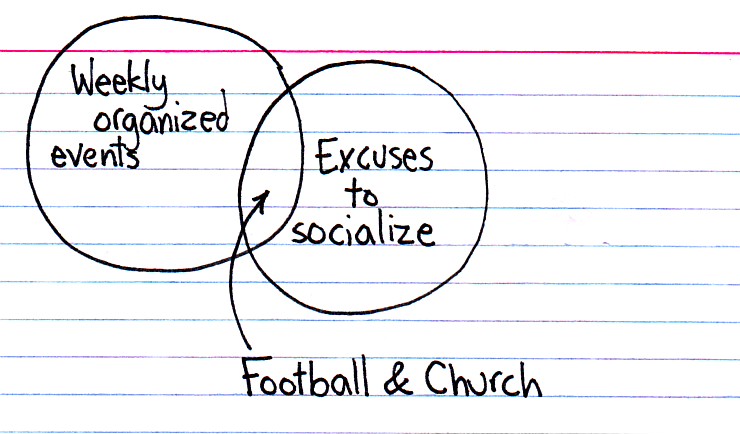

(Oh, and for the record, I'm undefeated in two fantasy football leagues as of now.)

This is How Disciples Are Made

Loved this video.  I think it illustrates quite well the paradigm shift many churches, denominations, and individuals are talking about.  It's looking at a more missional understanding of church. It's a little "American-centric" at the end...but if we overlook that I think it's helpful.

Enjoy.

11 Reasons for Humor And Joy

Advertisement: Young's The Hatter, 45 Wall St....Image via Wikipedia

This is from a book I'll have to read.  "Between Heaven and Mirth: Why Joy, Humor, and Laughter Are at the Heart of the Spiritual Life," by James Martin, S.J. Copyright © 2011 by James Martin, S.J.  I'm a firm believer in laughter...and, yes, laughter in church.

  • Humor and joy evangelize others by showing our hope.
  • Humor can shock listeners into recognizing reality.
  • Self-deprecating humor reminds us not to take ourselves too seriously.
  • Humor can speak truth to power.
  • Joy, humor and laughter show Christian courage in the face of adversity.
  • Humor deepens our relationship with God by encouraging us to smile in prayer.
  • Humor and laughter welcome others into a group.
  • Laughter helps in the healing process.
  • Humor fosters good human relations.
  • Laughter relaxes us and so opens our minds.
  • Humor is fun, a gracious gift to enjoy.


Enhanced by Zemanta

Rethinking "The Front Lines" of Ministry

'The Front Line' photo (c) 1918, State Library of New South Wales - license: http://www.flickr.com/commons/usage/
Jason Byassee, of Duke Divinity School has put a lot of thought into the notion of ministry being "The Front Lines" of religious work. It's a pretty common metaphor, that I know I've used myself once or twice. The image is that of pastors going off to seminary or Bible College or some education where they are given some knowledge and some training -- sort of "The West Point" of the religious system. And then the pastors become the infantry, heading out to do battle with the devil and the social ills of the world while some of the shots are called by the bigwigs, conference leaders, denominational administrators, the "generals" of the General Conference who never set foot out there in "the trenches of ministry." After all, what do they know about life on the front lines with the MRE rations of church pot-lucks, armor that can't protect against the weapons staff parish committees throw at their pastors, and ineffective "field manuals"?

A couple of problems here:

1) It's a little over-dramatic and violent considering parish ministry.
2) It claims that the work of seminary, and indeed, denominational leadership is not real ministry.

So Byassee offers a medicinal image to take the place of the more militaristic one:

The academy is like a laboratory where we try new things. Some blow up, some disappoint, others contain promise to offer cures. Then the pastor is the physician that Origen discusses in the “Philokalia.” The physician must know all the herbs in the garden, and she must know the precise malady of the patient. Then she can mix up the proper cure for whatever illness she faces. The herb garden is the Scriptures, the concoctions are their mixture in the tradition (a little Esther, some Revelation, and voila!), and their proof is in the health of the church. Both lab researcher and general practitioner are trained as physicians and aim to be healers.

This image still ranks the parish and the academy appropriately. It also judges the academy by how innovative it is in bringing forth new (and old) things for the sake of the church. And its telos is in the health of the body for which we all care.

It’s far from perfect, I grant. What do you think would be better?

Do you have something better to offer?

Brilliant Cartoon By "NakedPastor" (David Hayward)

I frankly didn't know how to title this post except "Brilliant Cartoon By NakedPastor." For those who just clicked here because you saw "Naked Pastor" in the title, I'm happy to point out that David is a former church leader, who now calls himself a "graffiti artist on the walls of religion." The nakedness he refers to is the baring of his soul and personality through his posts and drawings. He writes over here.

Anyway, this cartoon just blew me away. It's called "Sisyphus Revisited," recounting that famous Greek myth about a king who is forced to roll a big boulder up a hill only to see it roll back down, time and time again. It's a metaphor, perhaps, of how we struggle in life only to be faced with more struggles again. It's a metaphor, perhaps, for human pride in our accomplishments, which vanish away.

Regardless... This blew me away this morning.

How much over the last 11 years have I struggled for this church and how often has it felt as if God was pushing us back down...perhaps to make us realize we only build if he build and we only grow if he grows us?

How much to we try to lift up the church, here and around the world, only glorifying the church and not our God?

How do we give up the struggle and allow God to lift us up?

For me...

this morning...

this is brilliant.

Following Jesus Without Converting to Christianity

Jesus from the Deesis MosaicImage by jakebouma via Flickr

The quote below is from Gavriel Gefen's "Jesus Movements," in Mission Frontiers, May-June 2011 (p. 7).  I found it over at NextReformation.  What I find particularly interesting here is the notion of following Jesus -- and not following him lightly -- without feeling a need to convert to Christianity.  Such a notion flies in the face of much of my own education and formation, where belief in Jesus and being part of "Christianity" (and, by default, a church) was a no-brainer.

I have, over the years grown in my understanding of what it looks like to be a Christian and not be part of a church.  I'm pretty comfortable with that at this point.  However, I'm not sure I've ever thought that one could be a follower of Jesus and actually not consider themselves to be part of Christianity.

Interesting quote.

“There is a growing phenomenon taking place concurrently within at least every sizeable region of the world today. People within numerous different tribal cultures and also people within the cultures of each of the major world religions are increasingly accepting Jesus without converting to Christianity and without joining churches. ” They are encountering Jesus in ways that change their lives forever, without them leaving one group for another.

“They are learning to discover for themselves what it means to be faithful to Jesus within their own cultures and within their own birth communities. Conversion for them is believed to be a matter of the heart and not one of joining a different, competing cultural community.

“It is usually the case that after a number of these individuals within the same community are following Jesus, they begin meeting regularly as a small group. Over time this expands into multiple small groups among the same people group or within the same country. Eventually, it becomes established as a full-fledged movement of believers in Jesus that is outside of Christendom. It becomes a Jesus movement within another tradition. Does this mean they are living their lives outside the boundaries of biblical faith? Or, are they merely living beyond the boundaries of Christendom as a competing community?

“How did Jesus live as a son of Israel? Did he create a separate and competing community from the one that was already there? Did he tell people to leave their synagogues? Did he start his own synagogues?”

Enhanced by Zemanta

Christianity: There's Something More

Jesus Christ Crucifix                          Image via WikipediaBuying diet books won’t make you lose weight. Reading an auto-repair manual doesn’t make you a mechanic. Getting an online degree doesn’t make you an expert. Owning a Bible doesn’t make you a Christian, nor does joining a church. There is something more to it. 

It is easy to be spiritualistic without being spiritual; it is easy to believe in Jesus Christ without being Christlike. But it is impossible to be a disciple without discipline, and the longer we deny this simple fact, the longer our church will lack relevancy and power. 


--Rev. Dan Dick

Enhanced by Zemanta

Creating Consumers

"We live in a culture that has replaced soul with self. This reduction turns people either into problems or consumers...[E]veryone we meet is either a potential recruit to join our enterprise or a potential consumer for what we are selling; or we ourselves are the potential recruits and consumers." 

--Eugene Peterson

(HT/My friend, Tim)

Our "Girdwood Squirrel Revival" Sunday


We knew we had a squirrel in the church.  Friday it got into bags of chocolate chip cookies.  Saturday it came back and cleaned out one of our live traps (this was harder to set than I realized) and got into some oatmeal from the food pantry.  Saturday night it stayed away even though we tried to encourage it with three correctly-baited traps.  We loaded each with granola bars dipped in peanut butter.

Sunday we had church.

So did the squirrel.

I was about five minutes into my sermon at the early 8:30 AM worship service when I saw it crawl across one of the beams.  "There it is!"  I stopped and pointed.  Our 8:30 service is small and intimate.  We decided that even though the traps had been put away for worship, we'd bring one out and put it up high where right where the squirrel had just been.  We had a little break right there in the middle of the sermon while we got out a ladder and moved the traps.  (This, by the way, is not the most disruptive thing that's happened during a sermon of mine.  It ranks right behind a medical emergency -- where persons ended up being OK -- and a bear right outside the church window.)

We were prepared to hear the slam of the trap door and the sounds of a frantic animal who had merely been trying to get his paws on some peanut butter.  But the squirrel stayed away for the remainder of the worship service.  All was quiet.  The show was over.

And he stayed away from the 10 AM worship service too...at least until the end.  At that point, right before the closing song, some of the kids in back squealed as they ran out the back of the church and followed the squirrel into the library and saw a hole it ducked into. 

At the close of the worship service, the traps were moved out front and center.  Children peered into holes and wondered, excitedly if we'd catch him.

Then people went home.

Then, a third time the squirrel made an appearance.  This time it was during our administrative meeting.  We saw it run through the narthex, turn and look at us and keep going.

Later that afternoon, we came by the church and found one very unhappy squirrel in one of our cages.  our girls named him "Hammy" from the squirrel character in the "Over the Hedge" comic.  Hammy didn't seem very pleased although he had eaten the peanut butter.


We loaded him up in the car.


And, because everyone kept telling me that squirrels are smart and can find their way back unless you release them a long way away, we drove the squirrel all the way out to Portage, about 10 miles away, to the train depot there.


My girls released him.  And off he ran into the woods.


Hopefully he'll be able to find some food--food that's not in our church.

Hopefully he'll live a long and happy squirrel-y life.

Hopefully he hasn't told his friends how to get into our church.

What Are We Making Here?

036.365 Child's PlayImage by ReillyButler via FlickrIn the morning I sort through my RSS feeds.  It's my "newpaper" reading for the day.  Lots of technology and Apple feeds.  Lots of religious feeds.  And, these feeds often feed my soul as well. 

It's not every morning that, as I sort through my morning RSS feeds in Google Reader that I pause and think to myself THIS IS IMPORTANT.  It's important for me.  It's important today.  I find lots of good stuff.  No doubt.  But it's kind of rare that something someone else writes on another website finds its way to me and immediately resonates with what I have going on inside of me and my concerns and my growing edges and touches on what I'm finding so important right here, right now. 

But this morning it did.

This morning I'm emotionally recovering from Sunday.  It was a day we started on a new sermon series called "Awkward Family Snapshots from the Bible."  We're looking at the very dysfunctional families in Scripture and seeing how messed up they were and yet God was still able to bless them and bless others with them.  We have some messed up families.  I know our folks are pulled in so many directions and lament that their plates are so full and yet they see no way out.  But I want them to hear how God still blesses and used them.

It was a day that we seriously looked at some of the economic struggles facing our church and wondered why people don't give more and our leadership discussed the benefits of having a full-time pastor at the church.  What would ministry and our finances look like with a half-time pastor?  In the end, it's a matter of priorities.  It's a matter of discipleship, we said.  And looking for a short-term fix for a long-term problem wasn't going to be the way out.  We need people invested in the mission and ministry of the church not merely with us to see what they can get out of it on occasion.  This conversation was a weighty one for our family.

It was a day that I spent with family, heading out to the "hand tram" up Crow Creek Road.

It was a day for grilling out.

And now I'm left here, in the coffee shop, trying to plan and to lead and to disciple.

That's when I saw this post from the Missional Church Network.  It's a long quote from Renovation of the Church: What Happens When a Seeker Church Discovers Spiritual Formation by Kent Carlson & Mike Lueken.  I've not read the book.  It looks great from the quote.

I don’t know how to say this in a gentle way, but we should not assume that those people who are attracted to our church have been captivated by the message of Christ and his alternative vision of life. In truth, most North American Christians are not riding courageously on warrior steeds with swords waving wildly in the air, crying out, “Let’s change the world for Christ.” Rather, they come in the air-conditioned comfort of their SUV or minivan with their Visa card held high in the air, crying out, “Let’s go to the mall!”

We should be more truthful with each other here. They come because their high-school kid likes the youth program, or because their children don’t get bored, or because they like the music, or because the pastor preaches the Bible the way they believe it should be preached, or because they happened to be greeted by a smiling face one day, or because the worship leaders looks like Brad Pitt.

This is the hard, raw reality of life in the North American church. The people who come to our churches have been formed into spiritual consumers. This is who we are. It is our most instinctive response to life. And you can hardly blame us. Almost everything in our culture shapes us in this direction. But we must become deeply convinced that this is contrary to the teachings of Jesus Christ, the one who invited us to deny ourselves and lose our lives in order to find them. If we do nothing to confront this in our churches, we are merely putting a religious veneer over consumerism and nothing is changed. We offer no real, viable, attractive, alternative way of living. And what is worse, our churches become part of the problem. By harnessing the power of consumerism to grow our churches, we are more firmly forming our people into consumers. Pastors end up being as helpful as bartenders at an Alcoholics Anonymous convention. We do not offer what people really need.

I read this, coffee in hand this morning and repeated the last lines again a few times:

We offer no real, viable, attractive, alternative way of living. And what is worse, our churches become part of the problem. By harnessing the power of consumerism to grow our churches, we are more firmly forming our people into consumers. Pastors end up being as helpful as bartenders at an Alcoholics Anonymous convention. We do not offer what people really need.
Wow.

We offer no real, viable, attractive, alternative way of living...  Pastors end up being as helpful as bartenders at an Alcoholics Anonymous convention. We do not offer what people really need.

Our folks are not living in an alternative way.  I'm not sure I'm even living in an alternative way. And I'm supposed to be leading.

We offer no real, viable, attractive, alternative way of living....  We do not offer what people really need.

How do we offer what people really need?  How do we, not really a seeker-church, practice spiritual formation?

Questions are harder while money is tight.  Answering these questions long before a building process would have been the ideal way to go.  But here we are now.  A community of believers trying to make disciples of Jesus Christ for the transformation of the world while still trying to make disciples of ourselves.

But, if we're not making disciples here, then what are we making?

What are we making here?

Perhaps, from the quote above, we're just making more consumer of religion.

Enhanced by Zemanta

Moralism: Keeping the Riff-Raff Out of Church

Corcovado jesusImage by doug88888 via Flickr

As I look at this church in America, I struggle with this quote from John Fischer:

Much of what outsiders struggle with when it comes to church and Christianity is an imagined level of performance they assume is required of those on the inside. People think a certain behavior level is expected– a kind of incorrect thinking that keeps out the very people for whom the gospel of Jesus Christ exists. This is what keeps single moms away from church, even when they want to come and desperately need friendship and support. This is what keeps out gays and lesbians who are genuinely seeking God. This is what keeps out those who have had abortions, and the men who have caused them. Not to mention recovering addicts, ex-cons, the poor, the homeless, the mentally challenged. It’s starting to look like the crowd that followed Jesus around when he was here – lepers, the deranged, demon possessed, the blind, the lame, and the social misfits.

The church's incessant desire for moralism, this assumed standard of behavior, can make it impossible, not only for the message of grace to be heard but for it even to be proclaimed.  Where is grace when we tell societal riff-raff that they need to change their ways before they can become "one of us?"
Enhanced by Zemanta

The Business of the Church: Improving the Living or Raising the Dead?

"Christ Raising the Dead", Watercolo...Image via WikipediaEric Landry, over at Out of the Horse's Mouth, has what can be called, fairly, a scathing analysis of Willow Creek's Summit of business leaders and church leaders.  I think some of his criticism could be called, fairly, heavy handed.  I assume there are many things pastors of large or small organizations can learn from business leaders...from those who have found new and exciting and successful ways of leading people.  Lord knows I could learn a few things.

But, how much can we learn from business?  I know it is not terribly uncommon to hear business language in the church..."bottom line," "clients," even "product."  But the end goal of business is to make money.  While I'd love to be bringing in more money at our present church that's not "our business."  "Our business" isn't "getting more butts in the pews" -- although, again, it would be great if we had more of those as well.  Our business is offering Christ.  Our business is doxology, offering our praise.  Our business is discipleship.

Landry's most pointed, and I think strongest, theological argument is directed at Bill Hybells.  Here it is:

Bill Hybels said yesterday that the church is in the life transformation business. I’m glad to say that the Bible doesn’t support that view though it does seem to be a fairly common misconception today. We all want Jesus to come alongside us and improve us, our marriages, our children. We want to go to sleep at night confident that we have taken several steps forward, getting a little better every day. We want to reach the end of our lives and see that we have accomplished something of lasting significance and worth, to know that we were worth something. In all of these scenarios, however, Jesus is a means to an end (a very personal, therapeutic end: feeling better about ourselves). As one new acquaintance said at dinner last night, the problem isn’t that we need to align our hopes and dreams with Jesus; it’s that Jesus upends our hopes and dreams, intruding into our lives with such force that what we thought was important actually dies and new life is born in its place. As the great Episcopal preacher Robert Farrar Capon puts it, “Jesus came to raise the dead. He did not come to teach the teachable; He did not come to improve the improvable; He did not come to reform the reformable. None of those things work.” As long as the church thinks it is in the life business instead of the death business, it will constantly clamor after every tool to improve life and it will judge its success in the way that bookkeepers and accountants judge success.

Oooh... there's a few things I want to pull out of here.

I don't think I'd say that the church isn't about transformation, at least as the author here does.  It is true that much of contemporary Christianity is about "making you a better you."  It's about "improving the living."  That is partly why we now offer Alcoholics Anonymous and a Grief Support Group and why we've offered Financial Peace University.  But the author is right that this can't be the primary goal of the church and every sermon series on "Five Easy Steps to Improve Your Marriage" moves us closer to a gospel of self-help.  That's not the Gospel of Christ.

Secondly, that Robert Capon quote rocks.

Lastly, I do love the phrase "as long as the church thinks it is in the life business instead of the death business, it will constantly clamor after every tool to improve life and it will judge its success in the way that bookkeepers and accountants judge success."  This hit a little too close to home as we move towards a new accounting of membership and attendance in our churches.  Whose model are we following here?

I think, as it comes down to it, if we are all about "improving the living" instead of "raising the dead" we are selling Christ short, we're reducing his incarnation, death, and resurrection into something that we can get from Oprah or the next big CEO.  There is something much more radical and, dare I say, transformational, at work as persons are raised to new life in Christ...not just a marginally better life in him.
Enhanced by Zemanta

"Church Shopping"

Shopping carts in ABC Tikkula.                                          Image via WikipediaI've been engaged in some discussions with folks about church shopping.  In a simpler, more pleasant sense, this is what one does when you move to a new town and look for a church.  You try them all on for size and look at how fabulous the preacher is, what the youth group is like, if they have a nursery, etc.  You "shop" for a church to find the one that's right for you...for whatever reason.

Now, not all shopping in a consumer culture is merely about going out to get what you need.  In a consumer culture such as ours sometimes shopping is all about getting the latest and the greatest gadget or item.  It's about trading in your car every two years for a newer model.  It's about buying one more outfit for a closet that's already overflowing.

The same holds for church shopping in a consumer culture.  People are looking for the latest and greatest church.  People trade churches in for newer models.  Denominational allegiance is low and churches try to outdo one another in attracting the seekers, the unchurched, the dischurched people.

This can be a problem, in particular, for our smaller churches.  I noticed this much more in the first church I served in Indiana.  There were three United Methodist Churches in our town of 15,000 people.  Add to that an untold number of Presbyterian, Baptist (of all kinds), Catholic, Independent, Disciple of Christ, Pentecostal, etc. churches.  We were a small and we knew it.  We kept looking at some of the bigger churches and wishing that we could have the youth group or the choir or the facility that they had.  And we could tell from the faces of some of our visitors that they would never be back.  Perhaps it was the lack of a suitable nursery.  Perhaps it was the lack of air conditioning.  Perhaps it was a bad sermon from me.

I think this springs from the fact that many persons look at churches asking "What can the church do for me?" rather than "What can I do for the church?"  And when a church isn't meeting a perceived need, church shopping begins.

So, it was nice to see that this religious phenomenon isn't just an American issue.  I saw this cartoon yesterday over at Internet Monk.  The cartoon is from Great Britain.


This cartoon is taken from the Dave Walker Guide to the Church, published by Canterbury Press. It originally appeared in the Church Times.
Enhanced by Zemanta

What Could A Church Learn from a Gang?

Francis ChanImage by williamhartz via Flickr

A while back a former gang member came to our church. He was heavily tattooed and rough around the edges, but he was curious to see what church was like. He had a relationship with Jesus and seemed to get fairly involved with the church. After a few months, I found out the guy was no longer coming to the church. When asked why he didn’t come anymore, he gave the following explanation: “I had the wrong idea of what church was going to be like. When I joined the church, I thought it was going to be like joining a gang. You see, in the gangs we weren’t just nice to each other once a week—we were family.” That killed me because I knew that what he expected is what the church is intended to be. It saddened me to think that a gang could paint a better picture of commitment, loyalty, and family than the local church body. The church is intended to be a beautiful place of community. A place where wealth is shared and when one suffers, everyone suffers. A place where when one rejoices, everyone rejoices. A place where everyone experiences real love and acceptance in the midst of great honesty about our brokenness. Yet most of the time this is not even close to how we would describe our churches.
--Francis Chan
Enhanced by Zemanta