Showing posts with label Forgiveness. Show all posts

Grace is Free, But It's Not Cheap

This is a great video from People of the Second Chance


What a beautiful account of grace...of mercy...of forgiveness, plain and simple.

As I reflect on this video and the concept behind the movement, I can't help but remember Anne Taylor's Saint Maybe, which a book I had to read at Duke Divinity School under the guidance of Stanley Hauerwas.  In that book, "The Church of the Second Chance" features prominently, as a place of radical forgiveness.

I found an except of the book over at a commentary on Matthew 18 on the cost of forgiveness by Carl Gregg:

As the story goes, one day a plate glass window attracts Ian’s attention as he walks down the street. The window reads, “The Church of the Second Chance.” He can hear a hymn being sung by inside. He almost keeps walking, but instead quietly enters the church, and slips into a back pew, hoping not to draw too much attention to himself. After the service is over, Pastor Emmett introduces himself to Ian. As they talk, all the emotions Ian has been holding inside the past few weeks flood to the surface. He begins confessing to Pastor Emmett.

Pastor Emmett: What’s wrong, Ian?
Ian: I don’t even know where to start. So much has happened so quickly. It started when I told my brother…I told my brother that his wife was cheating on him. And then later that night…he drove into a wall.  Then a few days later his wife overdosed on sleeping pills. So I guess you could say I helped cause that too…more or less… He’d had too much to drink that night. I guess I shouldn’t have told him. But I was really mad. I’d been babysitting for him and his wife. And she should have been home hours ago. She made me miss a really important date with my girlfriend — or at least it seemed important at the time…. Now I’m not even sure she was cheating on him…. I mean I’m pretty sure she did in the past…. I know I wasn’t totally wrong….  So it looks as if my parents are going to have to raise the children. My sister’s busy with her own kids and I’m away at college most of the time…. Everything’s been dumped on my mom and I don’t think she’s up to it — her or my dad, either one. I don’t think they’ll ever be the same after this…. So anyhow, I prayed to God for forgiveness.  And I honestly believe it might have worked….  Oh, it’s not like I got an answer in plain English, of course.  But…don’t you think? Don’t you think I’m forgiven? I mean, I thought God forgives everything. But I just don’t feel forgiven.
Pastor Emmett: Ian, you can’t just say, “I’m sorry, God.” Why anyone could do that much! You have to offer reparation — concrete, practical reparation, according to the rules of the church. Jesus helps us do what we can’t undo. But only after we’ve tried to undo it. You, for instance, could begin by raising the children.
Ian: Raising the children? But I’m only a freshman? I’m away at college most of the time.
Pastor Emmett: “Then maybe you should drop out.”
Ian: Drop out? Drop out of college? …This is some kind of test, isn’t it?
Pastor Emmett: Ian, it’s not that simple. But God does want to know how far you’ll go to undo the harm you’ve done…. How else would God know?
Ian: Wait. You’re saying God would want me to change all my plans and give up my education?”  …That’s crazy! I’d have to be crazy! I can’t take on a bunch of kids!  Who do you think I am?  I’m nineteen years old! What kind of religion is this?
Pastor Emmett: It’s the religion of atonement and complete forgiveness…. It’s the religion of the Second Chance.

There's a rub here.

With video and The People of the Second Chance, it seems like the forgiveness, the second chance is completely free, nothing required, pure grace.  Could it be "too cheap?"

With Pastor Emmett and "The Church of the Second Chance," it seems like forgiveness has strings attached, is costly.  Could it not be "free enough?"

I struggle with this. 

I want to live in the forgiveness and grace of God but I'm not sure how much that forgiveness should cost me so that there is a purging of my sins, so that I can more readily be able to receive the gift that is given.  This has always been a struggle for me.  I've always struggled with forgiveness. I think going back to my childhood it's been a struggle for me.  I've always been more comfortable showing grace than receiving it.

So, how can I receive the free...but not cheap...grace of our God?

Or, the question I prefer to ask, how can I offer it to others?

My Forgiveness Quandary

'Forgive' photo (c) 2011, Ross Griff - license: http://creativecommons.org/licenses/by/2.0/
OK...  I'm troubled here.  That should come as no surprise.

Here's the story again....My lovely wife has been wronged.  An anonymous, and seemingly baseless, complaint was made about the schedule she's been trying to keep at the school.  Lots of dialogue with the School District and the Union.  The end result is that she was forced to resign from her School Librarian position which she loves.  And all of this appears to have happened over a minor issue that could have been resolved if the person who had the complaint had talked with my wife.  But, the person didn't.

This has made me angry.  We'll say, VERY angry.

I know that vengeance, anger, grudges, etc. are unhealthy, unholy, unneeded and will just tear a person up.  I know that.

And I know that forgiveness is the way to not only heal a broken relationship but heal the person who has been wronged, freeing them from the past.  I know that.

There's lots of awesome stuff in the bible about forgiveness.  It reads like a "greatest hits" album:

Colossians 3:13
Bear with each other and forgive whatever grievances you may have against one another. Forgive as the Lord forgave you.

Matthew 18:21-22
Then Peter came to Jesus and asked, "Lord, how many times shall I forgive my brother when he sins against me? Up to seven times?" Jesus answered, "I tell you, not seven times, but seventy-seven times. (NIV)

Luke 6:37
Do not judge, and you will not be judged. Do not condemn, and you will not be condemned. Forgive, and you will be forgiven. (NIV)

Matthew 6:14-16
For if you forgive men when they sin against you, your heavenly Father will also forgive you. But if you do not forgive men their sins, your Father will not forgive your sins. (NIV)

Mark 11:25
And when you stand praying, if you hold anything against anyone, forgive him, so that your Father in heaven may forgive you your sins. (NIV)

So, yeah, I should be moving on my way towards forgiveness.

I think it Corrie Ten Boom who said, "Forgiveness is to set a prisoner free and realize that the prisoner was you." I want to be free.  I know it's still early in the process, but freedom sounds a lot better than what my feelings were last week.

But...

Here's here's where I run into some problems:

What do you do when the wrong that has been committed against you (or, in this case, against someone I love) is anonymous...it has not been officially revealed who the person is?

What do you do when you still have to show up to work with the person you believe wronged you and, perhaps, still have your kids learning from him/her?

I know you can and should forgive regardless of the desire of the other to be forgiven (see the Corrie Ten Boom quote above). But, what do you do when the person who has wronged you denies their involvement...not giving you anything to really forgive?

Do you sense my quandary?

I'm in a "better place" with this issue THIS WEEK than I was LAST WEEK.

But there's a long way to go.

Going Off to Lead a Retreat on the Book "UnChristian" by David Kinnaman

Thought this was an appropriate cartoon from NakedPastor.com for the day.


LOST: Our Quest to Find Jesus -- "Jesus, The Forgiver" -- Sermon for 30 January 2010

Jesus forgivesphoto © 2010 R. M. Calamar | more info (via: Wylio)

Text:  Hosea 14:1-7 & Colossians 3:12-14
Title:  “Jesus: The Forgiver”

We have sanitized forgiveness in our culture.  We have lessened its impact.  We have made it easy…simple…quaint.

As a parent, I know there are times when we’re talking with our kids after an argument and we want one of them to say they’re sorry for whatever it is that they have done wrong and we want the other kid to say…even if it’s like pulling teeth to get them to say it… “I FORGIVE YOU.”  And this is a good lesson to be taught at an early age.  We don’t want our kids to stay mad at each other or us or someone else FOREVER.  There is some sort of emotional healing that comes with forgiveness, even for the little things, so that we’re not weighed down a desire to enact VENGEANCE BECAUSE WE HAVE BEEN SO WRONGED--or at least our kids can FEEL that they've been very wronged.


She destroyed my picture.

He told her that I liked her.

They went into my room without asking first.


It is good to let the pain and the hurt go.  Forgiveness means you won’t be a slave to that pain and hurt anymore.

But, you know, this type of forgiveness is FORGIVENESS-WITH-TRAINING WHEELS.  Most of the situations where forgiveness comes up in our lives we’d really be able to get through or get over without much emotional investment because, while we may feel hurt at the time, a little perspective and a little life happening to you can make you realize that, in the grand scheme of things, our hurt was pretty minor.

Where the rubber meets the road, though, is when those training wheels come up…when the hurt is BIG, where the pain is REAL, where your emotional investment is INTENSE.

Says Jared Wilson in his book, Your Jesus is Too Safe, which is serving as our springboard into these discussions, writes about forgiveness this way:


We have so sanitized forgiveness it’s all out of focus.  We idealize it as nice and virtuous, the dominion of children and their insignificant squabbles.  We forget, though, just how messy, how difficult, how scandalous forgiveness really is until were faced with the opportunity to experience it ourselves.  If you’ve ever cried out for a forgiveness withheld from you, or if you’ve ever had to face the sometimes excruciating process of forgiving someone who has really sinned against you, then you know what I’m talking about.  If you haven’t experienced either opportunity, just wait. (59)


We may say Jesus loves us, but when we have been wronged to our very core, we like to saddle up with our friend, the ANGRY JESUS.  He’s the one who can’t stand to be around sin for he is holy, and he can’t stand to be around injustice, for he is just, and he’s the one who says vengeance is mine and we’re more than happy to let him at whoever it was who hurt us so bad.

And so, we get angry.   And we stew.  And we simmer.  And we boil.  And we hold onto those feelings and can’t seem to avoid having them define us and shape us.  We can lose sight of Christ’s forgiveness, maybe not because we want to lose sight of it, but because our situation makes it so difficult to forgive.

One example…  When I was in seminary at Duke, I had a professor who talked with me about a class on forgiveness he was teaching.  After students had signed up for the class one girl pulled him aside.  She admitted that she had been raped and she wanted to take the class to forgive the one who did this to her.  That put a lot of pressure on the professor!  Well, as the class progressed, she came and talked with the professor, wondering if she should continue.  She just couldn’t forgive this person.  The professor asked if she WANTED to forgive.  Yes, she did.  Well, then, she was on her way, he said.  He said, when your pain is deep, forgiveness can be a long process.  Deep wounds don’t have quick fixes.  But, it’s still important to move along that direction.

The Bible, too, talks about forgiveness in difficult times.  One great example is rough.  It’s Hosea in the Old Testament. 

God wants Hosea to serve as an example of his own great love and forgiveness and relentless pursuit of his chosen people.  So he orders Hosea to marry Gomer, a prostitute.  Hosea obeys.  Gomer doesn’t stop doing what she had been doing.  Hosea is married to an unfaithful spouse and yet remains wedded to her, forgiving her at every step, never stopping loving her.  This provides us with a stunning image of the grace of God.  For God, in Hosea, is in a relationship with an adulterous spouse Israel, who has gone off seeking other spiritual suitors.  

These two images, the young woman in the class on forgiveness and Hosea and Gomer are not meant to shock.  They are meant to help explain the rawness of forgiveness and what’s really at stake here.  Our Gospel teaches us that this very human commitment to sin and pain and hurt has been overcome by a more powerful commitment on God’s part to restoration and healing and sanctification.  And, at times, it’s every bit as difficult as these two illustrations make clear.  Forgiveness is messy work. 

But, even though it can tear us up, we know that, the end of the process is a beautiful thing.

Hosea’s account, closes with a love song --- How could it possibly end with a love song, we may want to say?  -- But it does.  We read it before, but Peterson’s The Message translation puts it this way:


"I will heal their waywardness.
   I will love them lavishly. My anger is played out.
I will make a fresh start with Israel.
   He'll burst into bloom like a crocus in the spring.
He'll put down deep oak tree roots,
   he'll become a forest of oaks!
He'll become splendid—like a giant sequoia,
   his fragrance like a grove of cedars!
Those who live near him will be blessed by him,
   be blessed and prosper like golden grain.
Everyone will be talking about them,
   spreading their fame as the vintage children of God. (Hosea 14:4-7)


We may say this is beautiful.  We may say it’s wonderful that Israel will be restored into relationship with its God.  But we cannot say the “getting there” is easy.

I was once told by another professor, (and I paraphrase), “Grace stinks.”  It stinks because it means burying the hatchet, in the ground and not in a back. It means welcoming home someone who isn’t worthy of being welcomed.  It’s is offering mercy to the one who is unmerciful.  It is forgiving the one you can imagine ever forgiving.  And, if we are going to followers of Christ, we need to follow into this radical world of forgiveness where “Grace stinks” – because it goes against our better judgment, against the world’s teachings of right and wrong, and against our emotions that would rather sit in our angers and resentments.

This is scandalous.

And of course, Jesus made it even more scandalous.  Because here we have a carpenter’s son from Nazareth who now claims to be able to offer the forgiveness of God.

Think of the passage from Mark 2 and the paralytic man.  His buddies bring him to see Jesus but they can’t get in the door.  They peek through the windows.  They yell. Nothing.  So they get a ladder and go up the roof and start digging through.  They lower their friend to the feet of Jesus in the sure and certain hope that he would be healed.  And he is. And Jesus says, “My son, your sins are forgiven.” 

Forgiveness and the healing or restoration that accompanies it is found in this one man.

I think the main thing about forgiveness that confronts our delicate sensibilities is that the person who is forgiven doesn’t deserve that forgiveness.  It flies in face of all that we think is right and just.

I remember hearing a story about the Amish in upstate Indiana.  Apparently, one day, a group of teenagers was out joyriding and throwing rocks into Amish buggies as they passed by.  Nothing usually happened outside of some kids being mean.  But on this one day, the rock hit a baby who was in the back of the buggy and killed the child.  When the police started to press charges, the family said that they would not.  They forgave the teenage boys and would pray that they would receive and live into that forgiveness.  The police had no idea how to process this. It didn’t make sense.

Or, think about the Amish schoolhouse in Pennsylvania in 2006 where an armed man came and murdered five young girls before taking his own life.  And the Amish community said they harbored no ill will but forgave the man and have reached out to his family.

Or, this account given by Jared Wilson:


The same week of the Amish schoolhouse murders, one of our church’s pastors told the story of a mother who’d forgiven the drunk driver who killed her teenage son.  Not only had she found her way past the anger and bitterness to forgive the driver, but she and her husband had also pursued the messy work of reconciling a relationship with the man, EVEN THOUGH THEY HAD NO PRIOR RELATIONSHIP WITH HIM.  Her husband, who was a pastor, even presided over the man’s marriage. (66)


Look, I hope you’re never put in any one of these situations.  I pray that nothing I’ve said today will ever apply to your life in the same way.  I pray that the wrongs committed against you remain childlike, and involve little need for healing and restoration.  But if you ever find yourself in something like this, you’ll find that “Grace Stinks,” that forgiveness is painful, that fixing something that’s broken can require some great help from God.

Some things we need to understand about forgiveness:

First, FORGIVENESS IS NOT JUST FOR THE PERSON WHO'S FORGIVEN BUT FOR THE FORGIVER AS WELL.  By forgiving you free yourself from bondage to resentment.  You liberate yourself.  And this doesn’t matter if the person you’re forgiving is repentant or changed or accepts your forgiveness.  By forgiving someone, you claim that you will not be defined by that wrong that was done to you and that you will not keep the weight of that burden from living an abundant life.  You are freed.  You are more than that.

Now, as I’ve said, this may go against all that you’re feeling and all that you’re thinking when you’re in the midst of your pain.  Working through forgiveness can be infuriating.

Second, THIS WHOLE FORGIVENESS THING SPRINGS FROM THE FACT THAT WE ARE FORGIVEN. Remember Hosea and how his life of forgiving Gomer provided us a picture of what God’s forgiveness looks like.  That’s the forgiveness God offers to us.  We don’t deserve it.  It’s a free gift of grace.  That’s what grace is.  And we, who have been forgiven, are to forgive others.

We get reminded of this every time we say The Lord’s Prayer – “Forgive us our trespasses as we forgive those who trespass against us.”  Or, for the Presbyterians in the bunch, “Forgive us our debts as we forgive our debtors.”  Or, for those who like to shake it up in a little more contemporary way, “Forgive us our sins as we forgive those who sin against us.”  It all means the same.  We forgive because we have been forgiven.

Or, the Colossians passage,


Bear with one another and, if anyone has a complaint against another, forgive each other; just as the Lord has forgiven you, so you also must forgive.


It’s not dependent upon what the other person does.

Says Wilson,


[T]he moment you make your granting of forgiveness contingent on another persons’ attitude or worthiness, you’re slapping God in the face.  Again, this is why: you yourself are not WORTHY of God’s forgiveness.   You can never deserve it. You aren’t good enough or smart enough—doggone it, God didn’t grant you forgiveness because you’re likeable.  He did it because he loves you and because grace is the way he shows it. (72)


So, forgiveness is for the forgiver as well as the forgiven.  We forgive BECAUSE God forgives us.

Third, and last, WE FORGIVE AS WE HAVE BEEN FORGIVEN.

We are forgiven relentlessly, endlessly, patiently.  That is how we are forgiven.  That is how we are to forgive. 

If you remember, when, in Matthew, Peter asks how many times he should forgive.  Is it seven times?  No, it’s seventy times seven.  The point is not to stop when we get to 490 times.  The point is that it’s unending.  Just like Jesus’ forgiveness of us.

Two last points here as we wrap this up.

One.  Forgiveness does not make us doormats.  If you’re getting beat up by a significant other, you need to get away...protect yourself and your family before this can be worked on.  If you have someone who is picking bullying you at school, it’s OK to turn them in, get an adult to help.  If you have a spouse who is fooling around with someone, that extra-marital affair needs to stop for there to be healing in your relationship.

But by offering forgiveness, you give up the power that unforgiveness can have over you.  You bring a radical forgiveness to your relationship and ONLY THEN can true restoration occur.

Two:  We’ve talked about how difficult it is to offer a deep forgiveness.  I want to say it’s difficult to receive forgiveness too.  I have more problems with receiving than giving.  Receiving means letting go of guilt and shame.  Receiving means recognizing how your words or your actions or inactions affected those you love.  Receiving can mean forgiving ourselves.  In short, it means coming face to face with your sin.  Know that God’s grace is always greater than our sins.  And, perhaps, when we’re in need of forgiveness, we’ll find persons whose grace is greater than our sin as well.  It’s hard.  It's hard to find in the world.  But we should thank God when that’s the case.

In the name of the Father, and of the Son, and of the Holy Spirit.  Amen.

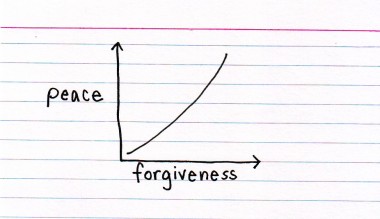
Peace and Forgiveness

Great little graph from over at Indexed.