Showing posts with label Salvation. Show all posts

The Bible, The Christ, and Evangelicalism

Bibles

Pastor and professor David Fitch offers the following critiques of evangelicalism, as based in his book The End of Evangelicalism. This is found over at "The Other Journal."

TOJ: You claim that the evangelical belief in the “inerrant” Bible has not really been about the truth but about “being in control of the truth.” It appears that just as evangelicalism continues to fracture into different hermeneutical camps, large church personalities have effectively replaced denominations in defending doctrine. Over this next decade, how do you see the fight of inerrancy shaping up?

DF: There’s a splintering of evangelicalism, and strangely, I would say that the majority of evangelicalism realizes that “inerrancy” is an apologetic strategy whose time is over. It is a strategy that in fact undermines Scripture by defining its authority via a reference point outside itself, by what is an “error” and who gets to define “error,” as opposed to what Scripture is in its relationship to the Incarnate Christ. Nonetheless, it wouldn’t surprise me if the New-Reformed movement among evangelicals makes inerrancy once again a shibboleth to determine who is a true evangelical. Once this happens, I think we’ll all be energized to expose the defensiveness in this move and move on to a true faithfulness.

TOJ: Another hallmark of the evangelical is the “decision for Christ,” but you write that this decision has effectively been “separated from one’s embodied life.” Could you explain that further, particularly how such a deep and personal decision has found such tragic separation?

DF: I refer to it as a separation because speaking of a decision for Christ doesn’t mean anything anymore. I am sure that is an overstatement. But what I try to show in the book is that the decision for Christ has become a master signifier that creates a fantasy, as if to make a person feel good for what he or she has done. Yet it demands nothing of this person. In essence it does what any good master signifier must do—it enables us to “believe without believing,” in Žižek’s famous words. It allows us to be Christians without it meaning anything material to our embodied existence. Nonetheless, conversion is at the heart of Jesus’s call to follow him. We need to recover conversion. I go much deeper into this whole phenomenon in the book. 

You can read more of the interview following the link above.

Here's Where I Find Myself Distancing Myself from Evangelicalism

Well it's ONE of the places. 

It's where evangelicalism has been so very focused on personal salvation as opposed to entering into the salvation story of God's people. 

I thin David Fitch hit the nail on the head as he described Scot McNight's book, The King Jesus Gospel:

I think pretty much everyone knows by now Scot McKnight’s contention that evangelicals equate the word “gospel” with the word “salvation.” Hence, according to McKnight, we evangelicals are really “soterians” not “evangelicals”. According to McKnight, the NT gospel should not and cannot be reduced to “our plan of salvation.”(39). Scot shows in King Jesus Gospel that the gospel according to the NT is best defined out of 1 Corinthian 15.  Here the Gospel is the telling of the whole Jesus Story as the completion of the Story of Israel, the lordship of Christ over the whole world. It is the summoning of people to respond to the completion of the promise to Israel in Jesus Christ as Lord.  Through the proclamation of the gospel, we are invited to enter into this grand work of God in history in Christ. Out of all this, we are saved and redeemed (here’s where salvation is part of the gospel but not to be equated with the gospel). Without the Story (of Israel), Scot says, there is no gospel (36). So Scot singularly does one thing in this book, he shows how “individual salvation” is part of the wider gospel. It is not the whole gospel. The salvation we as individuals receive is something we receive as we participate in the wider work of God in the world to bring in His Kingdom in and through Jesus Christ. Even this “personal” salvation is much bigger than “justification by faith” although it certainly includes that!

Sit With This Quote...

A sofa found in Starbucks, SingaporeImage via Wikipedia
...as you ponder salvation

...as you ponder evangelism

...as you ponder discipleship

...as you ponder whether we've made Christianity a "come to Jesus moment" rather than a "live in Jesus life."

...as you ponder contemporary evangelicalism and what mainline churches can offer

Sit with this quote...

We must focus on making disciples, not decisions. 

Now...I may have already made the focus on discipleship a long time ago...with spotty success.  But seeing it phrased this way kinda' blew my mind this morning as I sat with it, feet up, coffee in hand.

(HT/Rachel Held Evans)
Enhanced by Zemanta

Pluralism -- And Yet More Rob Bell

Ary Scheffer: The Temptation of Christ, 1854Image via WikipediaRob Bell. Rob Bell. Rob Bell.   Man, haven't we heard enough?

No!, I say.  This is good stuff.  This is good discussion.  And, a lot of the blogs I follow have taken sides on the "Rob Bell Issue."

Well, more fuel to add to our theological fire.

I was reading over at NextReformation.com about the ongoing debate.  There, I found a great quote about this issue.  The post closed with this quote from Leslie Newbigin.  This rides the fence in wonderful fashion.

“exclusive in the sense of affirming the unique truth in the revelation of Jesus Christ, but not in the sense of denying the possibility of salvation to those outside the Christian faith; inclusive in the sense of refusing to limit the saving grace of God to Christians, but not in the sense of viewing other religions as salvific; pluralist in the sense of acknowledging the gracious work of God in the lives of all human beings, but not in the sense of denying the unique and decisive nature of what God has done in Jesus Christ.” The Gospel in a Pluralist Society 1989 182-3
Enhanced by Zemanta

Rob Bell -- The Book and the Video Causing the Stir

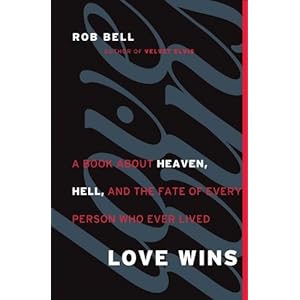
Here's the book (well, the cover of the book):


Here's the promotional video:


LOVE WINS. from Rob Bell on Vimeo.

Rob Bell in My Inbox (And Maybe in Hell, Too)

Well, this morning I sat down to go over my RSS feeds, using Feedly (which taps into Google Reader).  And, LO AND BEHOLD I FIND ROB BELL.  Not just a little Rob Bell, but A LOT of Rob Bell.  Rob Bell, for those who don't know, is the Pastor at Mars Hill Church in Michigan and behind the very popular Nooma videos (which we've used at Girdwood Chapel) and the Velvet Elvis Book (which I really enjoyed).

Well, he has a new book out called Love Wins and it's causing quite a stir as it appears that Rob either enters in to UNIVERSALISM or at least touches on it, perhaps saying that God's love is so big that hell is an empty place.  Let's be clear.  I've not read the book.  I'll probably read it after it's out next month.  So, all I'm doing now is reading reviews--by people who have not even read the book but all have their opinions.

But, I've been known to get my toes up to the line of universalism, but never able to cross over.  I want hell to be a small place because the grace of Christ is so big but I put my trust in God to make the final designation, knowing it will be good and just.  The words of one of my professors, Geoffrey Wainwright, still rings in my ears:

It may or may not be Christian to be universalist.  It is definitely NOT Christian to not want to be one.
There's a lot going on here.  Is universalism heretical?  What does our understanding of hell tell us about God?  Are Jews who were killed by Hitler, now with Hitler in hell?  Does God's holiness demand that hell is a big place and heaven for a select few?  Are those who believe in universalism damned to eternal fire? 

Hey, these are big questions.

So, it is with great anticipation that I saw all of these links today.

First, the cartoon above from Naked Pastor.

Second, an account of how the media has spread this from Challies.

Third, a post from Hacking Christianity which reflects on an anti-condemnation book getting condemned.

Fourth, Rachel Held Evans says Bell is asking some good questions that people are already asking:

Will only a few select people make it into heaven?

How does one become one of these few?

Are people like Ghandi and Anne Frank really in hell, along with millions and millions of other people?

Do we need a loving Jesus to rescue us from a hateful God?   Is this what the gospel is all about?

Is the gospel good news or bad news?

What is the essence of God's character?

Fifth, over at Connexions in Wales, one comment on a post says:

The early church seemed eager to excommunicate people over such matters as having the wrong tonsure. You’d think we might have learned something since then. Apparently not. Pharisaic Orthodoxy is so much easier to try than Christian love and grace, it appears.

Sixth, a more critical (and theological one) from Trevin Wax.  Read the comments to see how it shakes up.

And, lastly, from Justin Taylor and The Gospel Coalition, another critical look at Rob Bell's potential universalism.

Look, all of this is before the book has been released.

But I think we have here the classic debate between holiness and hospitality.  They are both good.  And I sometimes find it hard to camp out in the middle.

We'll find out more after the book release on March 29th.

Have We Over-Simplified Evangelism?

Here's an image of a tract found over at Jesus Needs New PR. 


We don't get many tracts in Girdwood, Alaska.  But occasionally we find a couple here or there.  I am sure that there must be some people, somewhere who come to belief in Christ through a tract they find on a bathroom sink or at the bus station or wherever.  I'm sure it happens.  But, if I remember correctly, the success rates are very, VERY, VERY small.

I think the tract above takes many of the tracts I've seen to a logical extreme.  We've reduced much of our evangelism into a simple question of choosing between heaven and hell.  It's more difficult than this.  It's messy.  It involves relationships.  It involves following Christ on good and bad days.  The way is narrow.  (I think I read that before somewhere :) )  To make it all a simple choice between to places in which you could spend eternity seems to make evangelism a piece of cake and takes all the struggle out of "coming to Christ" and "walking with Christ."

Furthermore, isn't it possible that this type of evangelical tool is "so heavenly minded that it's no earthly good."  Sometimes our stress on the afterlife, focusing on where persons are "going," makes us oblivious to their earthly trials and tribulations.  In other words, if they just check off "heaven" we can forget about them and go on to someone else.

Have you seen any bad tracts out there which have taken a similar road?

Does this make evangelism...and even salvation...too simple?

The Promise of Christ (Quote from Jared C Wilson)

Jesus on the wall of the senior HomeImage by freestone via Flickr

[Jesus] is the promise of salvation, both in his death and in his resurrection. It's by his death we get to avoid hell, but it's in his resurrection that we will one day see a glorious redemption from the pains of this world to the wonders of the next. The New Testament calls Christ's resurrection the firstfruits of more to come. This means that Christ's resurrection is a promise of our future resurrection. One day, you and I will get to slip out of these physical bodies, but God has promised, through the resurrection of the real person of Jesus Christ, to raise us up, and to fulfill our hopes for a new world where there's no pain or trouble or grieving or mourning or addictions or abuse or adultery or global warming or carsickness or morning breath. Amen? Isn't that a hope worth exulting over? Isn't that a promise worth desperately clinging to in the face of all life may bring us?

Christ's life is a promise to you--and me--of new life. Christ's death is a promise to us that death is not in vain. Christ's resurrection is a promise to us that we will rise up out of the grave one day, and the kingdom we live in spiritually now will one day drown out the kingdoms of this world for all eternity.

Jared C. Wilson, Your Jesus is Too Safe (34-35)
Enhanced by Zemanta

Consecration and Incarnation -- Salvation and Our Skin -- Christ and Community

Stained glass at St John the Baptist's Anglica...Image via Wikipedia

Clearly I have no idea how to title this blog post.  Perhaps I have way too much going on here.  But my heart and head are still spinning with the events of yesterday at our consecration.  I'm still a little raw.  I'm still moved and touched by all the show of support we had.  I'm still thinking ahead to all the ways this building is going to be used once we're in a position to use it.

As stated, we had our Consecration of our new church yesterday.  I had looked at all sorts of stuff online to help me shape the service.  A pastor friend gave me his services he had used at a consecration nearly 20 years ago.  I had never had to plan one of these and felt great pressure.  After all, the Bishop was going to be here. 

The problem with so much of the stuff I was looking at was that it was so "high church" and formal.  "Process with Bible and Cross."  Tons of ritual.  Lots of formal language.  It looked great for the right setting.  Our church is a lot more informal than this.  None of this was going to feel particularly "Girdwoodian."

This is not to say we don't have important rituals in our church.  No, rituals are very important.  We have communion every week and go through the full liturgy.  We have the kids come down for children's time.  We do the creeds often.  It all just seems to have a more informal feel to it.  It seems "common."  It seems "colloquial." 

Granted, this reflects me, personally.  However, from a theological perspective, I don't pretend to have some religious "realm" or state of being and some "secular" realm.  I really don't have a style of language I use in church and one I use at home.  Or at least I try not to. Because I don't think these two things can truly ever be separated.  When Christ became incarnate he, as Petersons' The Message says, "moved into the neighborhood" (John 1).  He entered this real world with its real people and the salvation he offered was for the real world...with our own language and culture and problems.  Yes, we need to be in awe of God.  We should fear God.  We should offer God reverence.  But we can do so by offering who we are here and now.  We stand before God, with all of our quirks and baggage and problems, and are redeemed in the real world and we offer that salvation to those around us in the real world.

"Come at once--come as you are" -- quote from Archibald Alexander

Archibald Alexander (1772-1851)Image via Wikipedia

“Do not for a moment suppose that you must make yourself better, or prepare your heart for a worthy reception of Christ, but come at once – come as you are.”

Archibald Alexander
Enhanced by Zemanta