Last week, as you may have heard, the US House of Representatives unanimously passed a resolution affirming "In God We Trust" as the official motto of the United States. This was in spite of the fact that no one was trying to get rid of the motto and in spite of the fact that we have millions of Americans jobless and hungry and in spite of the fact that a jobs bill from the President could have been discussed, debated, and perhaps approved in some part instead of spending time affirming something that no one attacking.
I can't help but think this, as with so many other congressional actions, was no more than political grandstanding. We have come to expect as much from our political leaders.
However, my attention gets raised up a notch when it's God's name that's mentioned and it's God's name that's used in the grandstanding. It seems to play into the Constantinian perspective of the United States where we believe we have God on our side regardless of our actions in the world and regardless of which battles we're fighting.
It is with this background that I read a good post from Bethany Keeley-Jonker over at Think Christian. It's not a long post, but it's a good one. She closes her post this way:
I’m troubled by the promotion of the motto, though, for a number of reasons. It smacks of the kind of empty piety that Old Testament prophets railed against. In Amos 5, for instance, God is really angry about displays of piety while people are mistreating the poor. Instead of talking about how much our country allegedly trusts in God, why don’t we demonstrate it via legal and communal efforts that show the fruit of the Spirit? If we truly trusted in God, would we need to scrawl our piety on state buildings?
I think as Christians we should be very suspicious of efforts by politicians to use our beliefs or their own to score easy points. My trust in God isn’t something I want to be put up to a vote at all. It’s something I want to work harder to demonstrate. While this is hard enough to manage as an individual, as a nation it seems even more treacherous.
Even the Israelites, God’s chosen people, screwed up regularly. We shouldn’t be surprised when we fail as well, but perhaps we should be careful about praying on street corners and ignoring the downtrodden among us.
As one comedian put it this week, perhaps we should reaffirm that we trust in God because clearly we can't trust our politicians.
(OK. I'll have a couple of posts on Steve Jobs today. Please forgive this Apple fanboy.)
This quote below caught my eye. And, frankly, it's not because it's a critique of Fox News. It's because it gives an alternative to the Liberal/Conservative framework that shapes so much of our dialogue.
This is a conversation Steve Jobs had with Rupert Murdoch. It's found at Poynter:
“You’re blowing it with Fox News,” Jobs told him over dinner. “The axis today is not liberal and conservative, the axis is constructive-destructive, and you’ve cast your lot with the destructive people. Fox has become an incredibly destructive force in our society. You can be better, and this is going to be your legacy if you’re not careful.” Jobs said he thought Murdoch did not really like how far Fox had gone. “Rupert’s a builder, not a tearer-downer,” he said. “I’ve had some meetings with James, and I think he agrees with me. I can just tell.”
Murdoch later said he was used to people like Jobs complaining about Fox. “He’s got sort of a left-wing view on this,” he said.
I love that quote, "The axis today is not liberal and conservative, the axis is constructive-destructive."
I don't view this as a left-wing perspective.
I don't take Jobs to mean that liberal=constructive and conservative=destructive. I could be wrong, but my assumption is that those who find them politically (or religiously?) liberal could either build up or tear down, using their words or positions to collaborate or rip each other apart. And, I assume, the same goes for those who consider themselves conservative.
That's a great way of looking at the world and I can hear Paul preaching to us from 1 Corinthians 8:1:
Now concerning food sacrificed to idols: we know that ‘all of us possess knowledge.’ Knowledge puffs up, but love builds up.
So, can we reach across political divides of liberal and conservative as long as we're trying to build up each other, our community, our country?
I have been accused of being both liberal and conservative and consider that kind of a badge of honor. But more than those designations, I pray that I am perceived as one who supports and nurtures and cares and heals and forges relationships between folks. I hope I'm among the "constructive."
Found this over at Pastor Dan's Grace Notes from Anchorage, just up the road about 35 miles or so. Pastor Dan's blog post was entitled "Commie God." Not sure I have the guts to do that. However, I do agree that there are some, let's say, more "socialistic" aspects of the Kingdom of God expressed in Scripture that doesn't get the same play from those who most vocally want to return to a Judeo-Christian politics. There's a whole lot in the Bible that deals with health care and poverty and unity that we'd have to deal with. While some on the Christian "left" my talk about all of this as "social justice" I think it sounds a whole lot like socialism when you hear it from the right.
Perhaps a better question of whether we'd want God as president is whether God could possibly be elected?
Found this over at GetReligion.Org. I'm wondering if Alaska would really be a Red or a Blue state here. It's clearly blue on the map, but we have a lot of red going on in our state as well.
Image by robertxcadenavia FlickrBy now, the news that Mubarak has stepped down, essentially forced out of power by the protests in the streets for the last 18 days, has spread. Yay! Democracy won! Life is good! Life is grand! The people are victorious! Woo hoo!
Well...
Now what?
What's next?
It's been great seeing the images on the TV every night and reading "Tweets" from a few thousand miles away. Our politicians have used the plight of the Egyptian people for their political gain. We need to remember, it wasn't OUR revolution. We just got to watch.
And, I think it's true, that now the news will fall on whatever the next hot news item is. Perhaps there's a military uprising in "Where-ever-istan." Perhaps the president of "Far-away-from-here-land" will have an affair or steal money or trash talk the US. And that will take our attention. We're fickle people when it comes to our news cycles.
But, we need to remember that, while it may be a new day in Egypt, it's not all rainbows and puppy-dogs. While I'm no fan of strong-armed dictators with secret plain-clothes policemen running around, taking people away from their families...there's little decision-making involved by the people themselves.
But, now the military is in control. And the work of the people is beginning. What's next? What matters now.
I found the following over at ReadWriteWeb and it has some good stuff in it:
What matters is that we, not just the Egyptians, are now living in a world where difficult things are possible, where beautiful things are doable. That changes everything. The writer Delmore Schwartz famously said, "In Dreams Begin Responsibilities." But when those dreams finally come true, you realize the responsibilities are just beginning.
Right now, control of Egypt has devolved into the hands of the country's military. Egypt's military is well-regarded and trusted, unlike its police and security forces, who are reviled. But a military-run Egypt replaces one kind of a problem with another. The people on the ground in Egypt now have the unenviable task of securing a transition from protest to power. As the Prussian prime minister Otto von Bismark said, "Laws are like sausages, it is better not to see them being made." There's going to be a lot of people who are going to have to hold their nose and make an awful lot of sausage.
Government is never as romantic as rebellion but without it rebellions are meaningless. If you watched and encouraged from the sidelines - on Twitter or Facebook - I kind of hope you stick around. The Egyptians are going to need cheerleaders more than ever.
So, as we look over to Egypt, we need to start cheering for them. And we can't forget that some of the hard work of governing is beginning.
Criticism is part of the lifeblood of democracy. No one is right all the time. But we should remember that there is a big difference between criticizing a policy or a politician and demonizing the government that guarantees our freedoms and the public servants who enforce our laws.
We are again dealing with difficulties in a contentious, partisan time. We are more connected than ever before, more able to spread our ideas and beliefs, our anger and fears. As we exercise the right to advocate our views, and as we animate our supporters, we must all assume responsibility for our words and actions before they enter a vast echo chamber and reach those both serious and delirious, connected and unhinged.
(Written by President Bill Clinton on April 18, 2010 on the 15th Anniversary of the Oklahoma City bombings. From an Op-Ed article in The New York Times.)
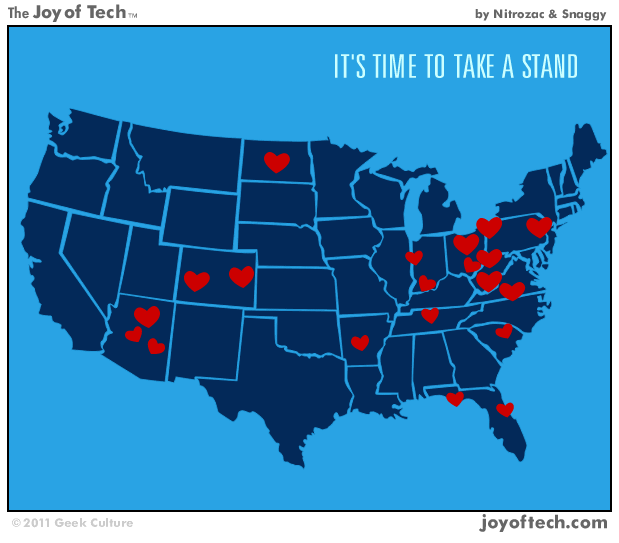
Interesting thing about Web Comics. They can be very current. Here's one I read regularly, "The Joy Of Tech Comic." It's a comic that talks about, well, tech stuff usually and a lot of social media. Today the artist twists the now well-known map which can still be found on Sarah Palin's Facebook site. Its the map of the US with which have crosshairs over the districts of House of Representative officials that her team wanted defeated in 2010. Gabrielle Giffords, who was shot yesterday, is represented by one of the crosshairs.
While her spokespersons have clearly stated that the crosshairs on the original map were not "gun sights" but "surveyors' marks" the Palin team has been forced to defend their poster and some of their rhetoric. To point people to her Facebook stage she had Tweeted, "Don't retreat. Instead -- RELOAD."
The Arizona shootings were the work of, it appears, one troubled person. To make a direct link between the map or Palin or the Tea Party or Republicans or whatever, and the shooter is dishonest. However, I think this cartoon, and current reaction to the event, has made it clear that we need to change the tone of our discourse.
I'll let this go without much comment...frankly because I'm nervous about how any words I say would be interpreted without an actual dialogue.
But I do love that last line:
“If this is going to be a Christian nation that doesn’t help the poor, either we have to pretend that Jesus was just as selfish as we are, or we’ve got to acknowledge that he commanded us to love the poor and serve the needy without condition and then admit that we just don’t want to do it.”
This editorial is from the Baltimore Sun from November 3rd -- the day after the election. It gets at some of the problems of putting what we want into the context of what we actually want to pay for or invest in.
After devoting long minutes to careful analysis of Tuesday night's election returns, I now know what Americans want:
We want roads and bridges that are always in good condition but do not require tax money for upkeep.
We want world class schools with teachers who are so dedicated that they will work for minimum wage. (Note: the best one should be in my neighborhood)
We want 60-inch plasma TVs that cost $200 and are produced by workers in Ohio making at least $30 per hour.
We want our military to win every war, every heart and every mind, everywhere, at no cost in lives or money.
We want cheap, clean, efficient mass transit that goes through someone else's neighborhood.
We want no-fat triple-decker hamburgers that are good for you and taste great.
We want fast, efficient, friendly government services provided by clerks who work happily for free.
We want "clean" coal and domestic crude that does not produce pollution or require digging or drilling.
We want SUVs that get 100 miles per gallon and produce jobs in Detroit.
We want Social Security benefits to go up and Social Security taxes to go down.
We want cheap labor from legal citizens who don't mind living in poverty.
We want clean drinking water and pristine parks and the right to dump anything, anywhere.
We want colleges that are inexpensive and not too hard but produce world class leaders.
We want football where every hit is brutal but no one gets hurt and baseball where everyone hits 40 home runs but no one uses steroids.
We want government to deliver all these things — then cut taxes and then cut taxes some more. Mostly, we want what we want, and we want it now.
Personally, I want leaders who will tell us frankly that all these things are not possible, that the blessings of infrastructure and education given us by our fathers are wearing out. I want thinkers who can paint a picture of a greater America that could exist in 50 or 100 years, and then unite us with a roadmap to get there. I want America to have a shared vision and an understanding that we all benefit when we all contribute, and that we all suffer when we demand only for ourselves. I want leaders who will tell the truth: that there is no free lunch.
But then, I also want the World Series to end in early October, yet I know that some things are just too grand to even wish for.
"Christians should put survival of the planet ahead of national security...Here is the mystery of our global responsibility: that we are in communion with Christ- and we are in communion with all people...The fact that the people of Nicaragua, Guatemala, El Salvador, Russia, Afghanistan, and Ethiopia are our brothers and sisters is not obvious. People kill each other by the thousands and do not see themselves as brothers and sisters. If we want to be real peace-makers, national security cannot be our primary concern. Our primary concern should be survival of humanity, the survival of the planet, and the health of all people. Whether we are Russians, Iraqis, Ethiopians, or North Americans, we belong to the same human family that God loves. And we have to start taking some risks- not just individually, but risks of a more global quality, risks to let other people develop their own independence, risks to share our wealth with others and invite refugees to our country, risks to offer sanctuary- because we are people of God"
This is from "The Road to Peace" and is quoted by Paul Martin on his blog, Turbulent Cleric.
I have been, over the last several years, in a constant effort to try to define myself for others. And this is not because I feel a need to be pigeonholed as a liberal or conservative or whatever, but because I think self-definition can be a tool to be in dialogue with others.
And it's a struggle.
For instance, while I do adhere to the traditional United Methodist understanding that "homosexuality is incompatible with Christian teaching" I've always felt uncomfortable with a lot of the antihomosexual dialogue coming from "the church" and am greatly aware that I have sin in my own life that is "incompatible with Christian teaching" as well. I've never felt like I could fully stand in judgment against homosexual practice because of my own need of redemption. Furthermore, I have some libertarian tendencies when it comes to government and, therefore, I take issue with the government enforcing "moral" issues. Well, this perspective has meant that many would have thought me too "liberal" in the midwestern Bible Belt of Indiana, but perhaps too "conservative" among some of my peers in Alaska. Furthermore, I really want to be able to listen and talk to those who disagree strongly with me and want to be open to persuasion. I don't claim I have all of the answers here.
Well, that's just one issue that I like to think I don't really fall into some of the traditional "camps."
Biblical interpretation is another one. I believe that all of scripture is "inspired" by God -- the good, the bad, and the ugly--the easy stuff and the hard stuff. Therefore I want to take seriously all of Jesus' words about reaching out to the poor and the outcast, those outside of the traditional confines of the church. Now, if one looks at my life, it's right to question whether or not I'm doing much to reach those "outside of the traditional confines of the church" but I hope that in some of my actions, and definitely in my preaching, this comes through. Well, when you talk about the poor and the outcast it kind of thrusts you into the "liberal camp" in today's world. I know there are a good many conservative Christian folks doing great work with poverty and world issues. I celebrate that and I celebrate that they can do so and never bend from their "conservative credentials." However, it's hard to preach about the poor man, Lazarus, at the rich folks' doors and not be branded liberal...or worse..."socialist."
Yet, amidst all of this self-reflection I don't waver from the assumption that this Gospel message we have, the good news of Christ's life, death, and resurrection, is a message to be shared with this world. I believe it is a "saving" message although I don't presume to understand all the nuts and bolt of the soteriology involved. And, I'm not a big fan of the "in your face," "this is the day of your salvation" evangelism of some of my sisters and brothers in the church. I'm in it for the long haul. I'm in it for the relationships. I'm in it grow and learn and live life together, journeying with Jesus.
So what does this make me? I don't know.
However, I came across Paul Martin's blog from Bideford in the UK. He's a Methodist minister over there and describes himself this way:
I am theologically a liberal evangelical. I believe that faith influences political judgments so I am a convinced believer that it is imperative to support the poor and the powerless and to seek to promote their interests above all others. If this puts me on the left so be it.
So, am I a "liberal evangelical?"
Perhaps I'm a "Moderate Evangelical" and it's just that in today's world with conservative Christians talking loudest, moderate seems more left than it has been for a while.
Then again, maybe it doesn't matter and, instead of trying to define myself or worry about being defined by others, I should just focus on what I'm doing--trying to be faithful to the claim Christ has on my life and live that out in community, sharing, as best I can, the message that I have received.
Since a lot of what I've written about is political, I thought I'd take the "Political Spectrum Quiz" found over at GoToQuiz.com. Mind you, the "spectrum" is incomplete and, while it allows some room to finesse answers, I found it to be unsatisfactory. Moreover, when I think about how all of this plays out religiously, I'm aware that belief in the resurrected Christ and the Christian teachings can shape us to come up with some different answers to the questions. Nevertheless, I thought this was a fun exercise.
To begin, here's my spectrum which is actually pretty average for those who have taken the quiz so far. I figured I'd be a little to the left. I'm surprised I'm not a little more libertarian.
My Political Views
I am a center-left moderate social libertarian
Left: 1.79, Libertarian: 2.21 Political Spectrum Quiz
As for foreign policy, I came down pretty squarely on the left. This is, I'm sure, mostly because of my pacifist answers to questions. As has been said, "There is no way to peace, peace is the way."
As for culture, I come down pretty well on the cultural liberal side of things, as opposed to cultural conservative. This is where my "libertarian" side of things comes through.
Somehow this puts me close to the center. In the grand scheme of things, this shows me pretty close to middle of the road. I hope that means I have a well thought out political philosophy and not that I'm ambivalent.
One aspect of quiz is that it asks you to rate how big a deal each of the answers were. I think, perhaps, this is one place I could have expressed my opinion a little better.
Well, take the test if you like. You can find it HERE.
For my part, I found Stewart's last commentary to be extremely effective, if only because it inspired me to take a searching self-inventory. Here's the question I asked myself: Pick a political opponent, someone you really hate, in terms of political positioning. Yeah, it might be knives out between you and them, in terms of cap and trade or tax policy, but ask yourself: would you celebrate their daughter's graduation from college? If they told you their father had died, would you lend a consolatory embrace, or would you take a secret glee? If they were broken down at the side of the road, would you pull out and offer up your jumper cables, or drive on by....
So, while I wasn't too terribly impressed with the comedic content on this occasion, I was nevertheless plenty moved by Stewart's soliloquy on decency and how the overamplification of our worst impulses and arguments tend to overshadow it. It's a tough remember at election time. We're taught to think of democracy as two sides that want a chance to steal the other's birthday, instead of a democracy in which ideas compete with one another. But we go on with life together, once elections end. When's the last time someone you disagree with actually came through for you when you needed it? For me, it was this morning. Keeping that in mind would be an eminently sane and decent thing to do.
Pastor Jenny, at Anchor Park and East UM Churches in Anchorage already posted this before. But, I'll do it here too. I'm sure there are others out there that have drawn attention to this speech where a comedian stops being funny (more or less) and tries to get serious about our need just to be civil...decent...with each other. And he puts a lot of the blame on the media which, for all of the political talk, seems to be the one constant villain in Stewart's shtick.
I've highlighted some of the text below that I think is pretty important as we discuss our discourse.
Here's a video.
Here's the transcript with highlighting.
And now I thought we might have a moment, however brief, for some sincerity. If that's okay - I know that there are boundaries for a comedian / pundit / talker guy, and I'm sure that I'll find out tomorrow how I have violated them.
So, uh, what exactly was this? I can't control what people think this was: I can only tell you my intentions.
This was not a rally to ridicule people of faith, or people of activism, or look down our noses at the heartland, or passionate argument, or to suggest that times are not difficult and that we have nothing to fear--they are, and we do.
But we live now in hard times, not end times. And we can have animus, and not be enemies. But unfortunately, one of our main tools in delineating the two broke.
The country's 24-hour, political pundit perpetual panic conflictinator did not cause our problems, but its existence makes solving them that much harder. The press can hold its magnifying glass up to our problems, bringing them into focus, illuminating issues heretofore unseen. Or they can use that magnifying glass to light ants on fire, and then perhaps host a week of shows on the dangerous, unexpected flaming ants epidemic. If we amplify everything, we hear nothing.
There are terrorists, and racists, and Stalinists, and theocrats, but those are titles that must be earned! You must have the resume! Not being able to distinguish between real racists and Tea Party-ers, or real bigots and Juan Williams or Rick Sanchez is an insult--not only to those people, but to the racists themselves, who have put in the exhausting effort it takes to hate. Just as the inability to distinguish terrorists from Muslims makes us less safe, not more.
The press is our immune system. If it overreacts to everything, we actually get sicker--and, perhaps, eczema. And yet... I feel good. Strangely, calmly, good. Because the image of Americans that is reflected back to us by our political and media process is false. It is us, through a funhouse mirror--and not the good kind that makes you look slim in the waist, and maybe taller, but the kind where you have a giant forehead, and an ass shaped like a month-old pumpkin, and one eyeball.
So why would we work together? Why would you reach across the aisle, to a pumpkin-assed forehead eyeball monster? If the picture of us were true, of course our inability to solve problems would actually be quite sane and reasonable--why would you work with Marxists actively subverting our Constitution, and homophobes who see no one's humanity but their own?
We hear every damned day about how fragile our country is, on the brink of catastrophe, torn by polarizing hate, and how it's a shame that we can't work together to get things done. The truth is, we do! We work together to get things done every damned day! The only place we don't is here (in Washington) or on cable TV!
But Americans don't live here, or on cable TV. Where we live, our values and principles form the foundation that sustains us while we get things done--not the barriers that prevent us from getting things done.
Most Americans don't live their lives solely as Democrats, Republicans, liberals or conservatives. Americans live their lives more as people that are just a little bit late for something they have to do. Often something they do not want to do! But they do it. Impossible things, every day, that are only made possible through the little, reasonable compromises we all make.
(Points to video screen, showing video of cars in traffic.) Look on the screen. This is where we are, this is who we are. These cars. That's a schoolteacher who probably think his taxes are too high, he's going to work. There's another car, a woman with two small kids, can't really think about anything else right now... A lady's in the NRA, loves Oprah. There's another car, an investment banker, gay, also likes Oprah. Another car's a Latino carpenter; another car, a fundamentalist vacuum salesman. Atheist obstetrician. Mormon Jay-Z fan.
But this is us. Every one of the cars that you see is filled with individuals of strong belief, and principles they hold dear--often principles and beliefs in direct opposition to their fellow travelers'. And yet, these millions of cars must somehow find a way to squeeze, one by one, into a mile-long, 30-foot-wide tunnel, carved underneath a mighty river.
And they do it, concession by concession: you go, then I'll go. You go, then I'll go. You go, then I'll go. 'Oh my God--is that an NRA sticker on your car?' 'Is that an Obama sticker on your car?' It's okay--you go, then I go.
And sure, at some point, there will be a selfish jerk who zips up the shoulder, and cuts in at the last minute. But that individual is rare, and he is scorned, and he is not hired as an analyst!
Because we know, instinctively, as a people, that if we are to get through the darkness and back into the light, we have to work together. And the truth is there will always be darkness, and sometimes the light at the end of the tunnel isn't the promised land.
Image via Wikipedia
I spend some time reading Allan Bevere's blog and his post today rings with what I've been thinking about and have written about below. Today he has a post by Michael Kruse, who's blog is now on my subscription list after checking it out today. His post is about how, we make our political opponents into "fools" or "self serving" persons. We perceive them as being out only for themselves and fail to see the substance, either or their arguments or our defenses against it. (This sounds pretty similar to my discussions below about the need to transform our political discourse.)
Nearly a century ago, a young boy named Ezekiel Bulver overheard his parents arguing. It seems Mr. Bulver was trying to convince Mrs. Bulver that any two sides of a triangle are longer than the third. Finally, in exasperation, Mrs. Bulver exclaimed, "You just say that because you are a man!" That was the end of the argument. Ezekiel had an epiphany.
Traditionally you were required to demonstrate that your opponent is actually wrong in a dialog before explaining what led to his erroneous conclusion. What young Ezekiel discovered is that you can bypass that demonstration and fixate on how your opponent became so silly (or evil), thus diverting all attention from the substance of the issue. C. S. Lewis claimed that the mythical Ezekiel Bulver is the founder of modern day political discourse. And if you've been paying any attention to politics lately, you see Bulverism is alive and well.
But this is far too simplistic a view of how people vote--only looking out for themselves or voting in a way that just doesn't make sense. Kruse argues that, when it comes down to it, most people pretty easily will vote against their own interests if they have a different understanding of what constitutes the common good. Therefore, a person with wealth might vote to increase taxes if they believe it is in the better interest of the common good to see medicare benefits expanded. Or, a poor person might believe the common good is best served by having leaders who will tighten restrictions on abortion or gay marriage, even if that means they will also vote against some social services that he or she uses. It's a different understanding of the common good. But, because of Bulverism, we fail to see the perspective of the other and can only demonize them. We make jokes. We make up lies. And we send it all as e-mails to those we think are like-minded friends.
Kraus closes his article this way:
Most political choices we make are about weighing competing values and concerns. For instance, in America, there has been a general belief that government has a responsibility for a basic social safety net. But this responsibility is a supportive one, not one of controlling citizens' lives. If politicians err too far toward weakening what is considered fair, they lose elections. Similarly, if they err too far toward an imperial model, they also get the boot. Reasonable compassionate people weighing the variables can come to differing conclusions. But the thrust of our age is to deny this reality in favor satisfying Bulveristic hunger.
I think the challenge for Christians in our polarized political environment is to begin a resistance movement against Bulverism. It is appropriate to occasionally have strong convictions about a particular issue or candidate. But as we talk with others, is it necessary to assume the worst about our opponents? Instead of beginning discussions by asserting how silly and/or evil our opponent is, is it possible to begin with assuming positive intent from our opponent, believing our opponent is seeking the common good, and searching for the value we can affirm in what our opponent wants to achieve? We may still come to conclusions that some are indeed silly or malicious, but just maybe by resisting Bulverism we will find that the great majority of us really have something in common: we are seeking the common good.
I cut out a big part of the middle of the article in the hopes that anyone reading this will check it out over here. I think this is helpful as we try to change our level of discourse.
Image by PinkMoose via Flickr
This may be more revealing than it should be. I normally play my political cards pretty close to my chest. I find it's best not to be pinned down, politically, so that I'm able to have intelligent conversations with those to the left of me and those to the right of me without being pigeonholed.
My own children have noted that I seem to be able to talk respectfully and discerningly with person with whom I disagree, even passionately. I try to be open to their perspectives and try to see what life experiences and history and theology have shaped their beliefs. I also don't want anyone to have preconceived notions about what I believe -- which I know they already do. I don't want anyone to prejudge me for that they assume will be my opinion -- which I know they already do. I don't want to miss a chance to be able to really hear the heartfelt opinions of others as I try to know them better.
Now, I like to think this makes me a pretty rare species in today's world. In the world today, as I look at it, we have some very strict boundaries around our political groups. And, while we may have politicians who claim they "reach across the aisle," we really know that this phenomena of "aisle reaching" doesn't happen much at all. Take a look at all the votes in the Senate and Congress that fell right down along party lines. Those aisle are made for walking, not crossing.
Here in Alaska we have a hotly contested battle for a Senate seat with three candidates in the race running just about even. But each of them has their problems.
The Democrat, Scott McAdams suffers from...well...being a Democrat in a very Republican state...that and a lack of experience beyond being Mayor of a small town.
The Republican, Tea Party-Approved candidate, Joe Miller suffers from his connection to the Tea Party and questionable ethics (such as a dishonesty in his job as lawyer and then trying to cover it up).
Republican write-in candidate Lisa Murkowski suffers from her inability to abide by the results of the Republican primary, which she lost to Joe Miller.
There is a certain amount of nastiness between the two Republican camps and it's clear in our own town that supporters of these two candidates have had a field day taking down and/or vandalizing the campaign signs of the other.
It's a heated...yet very interesting race. And, of course, we're bombarded by mailers and robocalls on a regular basis. There are other races going on and there will be more to vote on when Tuesday comes. However, these are the folks getting most of the attention.
As this is happening around us and as we struggle with what it means to try to choose between candidates when we're not sure how trustworthy they are, us clergy have received a bit of bad news and it came to me in the form of an article by Michael Jenkins, President and Professor of Theology at Louisville Presbyterian Theological Seminary:
According to a survey conducted by “Scientific American,” “religious authorities” rank at the bottom of eight categories of persons trusted “to provide accurate information about important issues in society.” On a 1 (strongly distrust) to 5 (strongly trust) scale, clergy (at 1.55) ranked below “elected officials” (1.76), “companies” (1.78), “journalists” (2.57), and “citizen groups” (2.69).
I want to reiterate this point, just so we don’t miss it: ministers rank below politicians in believability and trustworthiness.
Maybe we have one piece of the puzzle why folks are not beating a path to the doors of the church...
Clearly, those of us who are in ministry have some fences to mend. Or, to reach back to the jargon of the sixties when the phrase was first coined, we have a “credibility gap” that needs to be bridged. The only way to gain trust is to earn it.
So, we are left to ponder why this is the case? The media? A couple bad apples spoiling the whole barrel? A disconnect between the teachings of Jesus and the behavior of those in the church?
And, regardless of the reasons behind it, we are left to try to figure out what to do about it. My take is that we are left to slowly but surely work on real relationships with persons where our trustworthiness is shown and lived out. I'm not sure anything else will be able to bridge this divide.
Here’s a simple example. Think about yourself if you had just spent three years with Jesus. How would you treat illegal immigrants? For vast numbers of typical American Christians, their immediate instincts are to either argue a political position or look for a way to end the conversation. . . . Some of [their] answers could be better, and some could be a lot worse, but it’s the process of how we consider the issues that matters to me. (Mere Churchianity, p. 51.)
What if Jesus were standing right next to us when we had to say something about a controversial topic? Because he is, of course, and as Christians we should try to speak with his voice.
Here’s your challenge. Write about the issue of illegal immigration and illegal immigrants from the point of view of Jesus. You’ve spent years with him; what would he say or do about the issue?
Don’t offer political or social commentary, don’t quote any pundits or talk-show hosts, and most importantly don’t start anything with, “Well, I think . . .” The exercise here is getting away from our own immediate opinions and trying to think as the Son of God would think. Don’t worry about whether your answer is or isn’t politically viable or likely to happen. Jesus didn’t, even though he knew where his words and actions would lead him.
You will probably need to do a little Bible study, but I don’t want a flurry of proof texts. Consider the issue with these guidelines in mind:
What does Jesus think about laws? About just or unjust laws?
What does Jesus think our attitude and behavior toward laws ought to be, just and unjust?
How does Jesus treat people such as illegal immigrants?
How does Jesus treat people with the authority to enforce laws?
It would be good if people from other countries answered, too. Illegal immigration is an issue everywhere, but again, I don’t want a particular country’s attitude toward the topic, I want thoughtful exploration of Jesus’ will.
One more rule — Treat others’ comments kindly, even if they differ from yours. Although we are trying to be like Jesus, we aren’t Jesus. Humility is the order of the day.
So iMonks, sharpen your quills, defrost your ink, weigh down the corners of your parchment, and begin!


 Image via Wikipedia